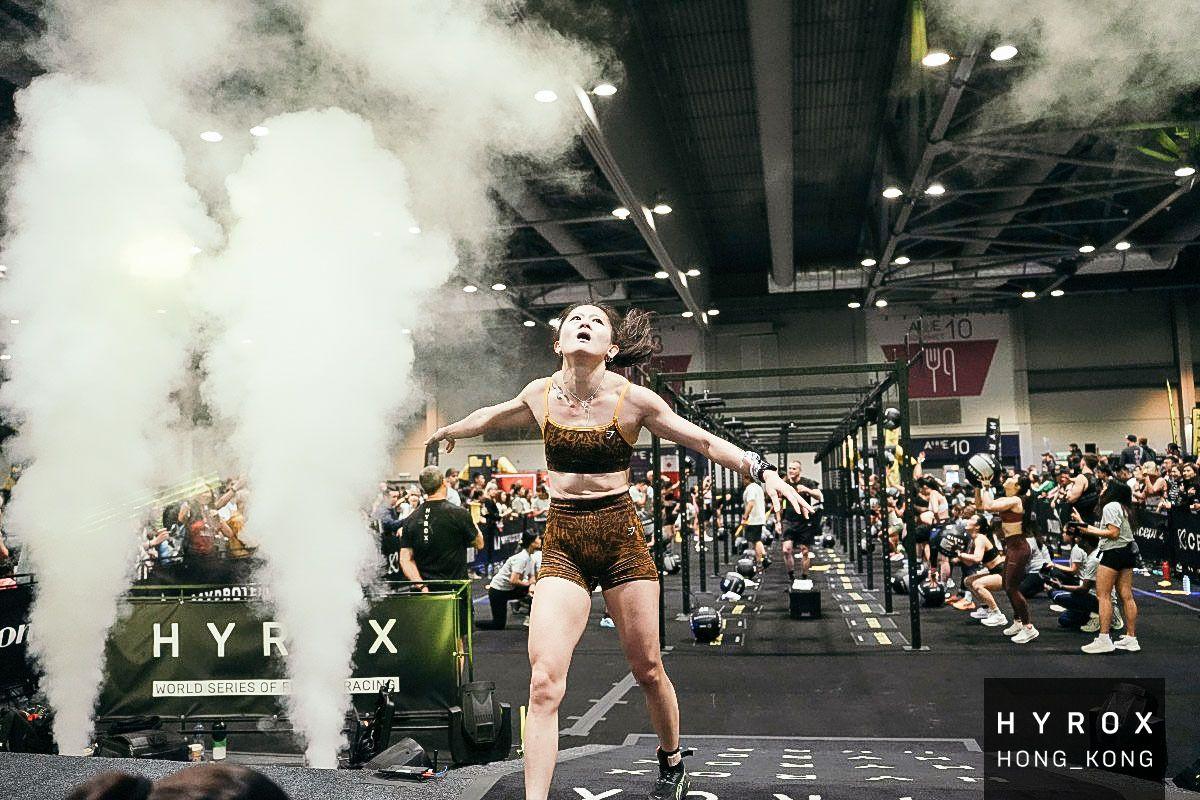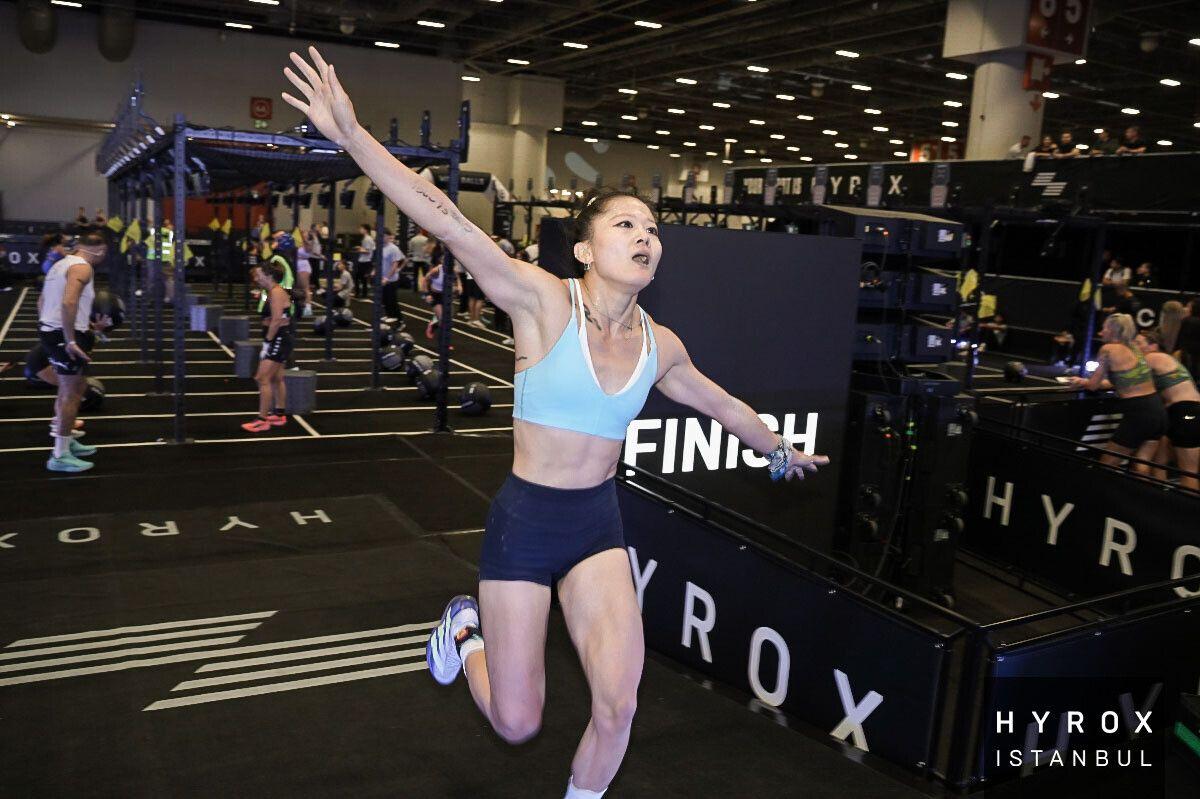
Hi everyone! I'm Pauline Yu (PYY), Taiwan's only 4× Hyrox World Championship qualifier. I still remember the weeks leading up to my very first Hyrox race — I was frantically searching the internet trying to find out what a realistic finish time actually looked like for a woman at my fitness level. Nobody gave me a straight answer. Every forum post I found was either from a super-elite athlete or so vague it was useless. I showed up on race day with a completely unrealistic goal in my head, went out too hard in the first two running legs, and completely fell apart by the sled push. I finished, but I was a mess. That experience is exactly why I wanted to write this article — because setting realistic Hyrox first race goals is genuinely one of the most important things you can do for yourself before you step on that floor.
Key Takeaways
- ▸For most women completing their first Hyrox race, a realistic finish time sits between 1 hour 20 minutes and 1 hour 50 minutes — the exact range depends heavily on your running base and how efficiently you move through the eight functional stations.
- ▸Your running pace across the eight 1 km segments is the single biggest lever you can pull — even modest improvements in your running economy will shave meaningful minutes off your total Hyrox finish time.
- ▸Station transitions matter far more than beginners expect — practising moving from a running effort directly into a heavy functional movement in training will save you confusion, hesitation, and lost time on race day.
- ▸Setting a time goal that is process-focused rather than outcome-focused — for example, targeting a consistent running pace rather than a podium finish — dramatically reduces anxiety and actually leads to better overall performance for first-timers.
- ▸Women's elite Hyrox athletes in Asia, including myself here in Taiwan, train for years to crack the sub-60-minute barrier — so please be kind to yourself and treat your first race as a learning experience above everything else.
What Nobody Tells You Before Your First Hyrox Race
Before I qualified for the Hyrox World Championships the first time, I had to go through several races where my expectations and my actual performance were completely misaligned. The very first lesson I learned — and it was a painful one — is that Hyrox is not a race you can fake your way through with general fitness. I had been doing CrossFit and running half-marathons for two years before my debut. I thought I was ready. What I didn't account for was the cumulative fatigue that builds across eight rounds of running and eight stations. By the time I reached the rowing station, my legs were already fried from the sled push, and I genuinely considered just sitting down on the rower and crying. I didn't, but the thought was very real. That race taught me that Hyrox demands a very specific kind of fitness — it's the overlap of aerobic capacity, muscular endurance, and mental grit — and none of those three things can fully compensate for a weakness in the others.
For women attempting Hyrox for the first time, especially here in Taiwan and across Asia where the sport is growing rapidly, the most common mistake I see is anchoring a goal time to an elite women's Hyrox result rather than to personal training benchmarks. I completely understand the impulse — you watch highlight reels on Instagram, you see women's elite Hyrox athletes finishing in under 60 minutes, and you think 'well, I run regularly, so maybe 75 minutes?' The truth is, even 75 minutes for a first race requires a very strong aerobic base and genuine familiarity with every single station. A more honest and genuinely achievable Hyrox first race goal for most active women is somewhere between 1 hour 20 minutes and 1 hour 50 minutes — and hitting that range on your first attempt is something to be genuinely proud of.
- ▸Do a time trial before race day: run 8 km at a comfortable but continuous pace, then note your average per-kilometre time — this single number will be your most reliable anchor for projecting a realistic Hyrox finish time.
- ▸Practise every station at least five times before your first race, because unfamiliar movements burn far more mental energy than physical energy — and mental fatigue in Hyrox is real and it will slow you down.
- ▸Build your target time in segments rather than as a single number — estimate your running time across all eight kilometres, then add a realistic station time based on practice, and only then do the addition to get your overall goal.
- ▸Give yourself a five-minute buffer on top of your calculated goal time, because race-day adrenaline, crowded stations, and small navigation errors inside the venue will eat into your projected time in ways that are almost impossible to anticipate in training.
How to Actually Break Down a Realistic Hyrox Time
Let me walk you through the way I personally think about goal-setting for a Hyrox race, because I think this framework will help you enormously. The race structure is elegantly simple on paper: eight runs of 1 km each, with one functional station between every run. The running totals 8 km across the entire race. If you run each kilometre at 6:00 per kilometre, your pure running time is 48 minutes. Add the station time — which for a first-timer doing everything methodically might be anywhere from 30 to 45 minutes depending on how heavy the weights feel relative to your strength — and suddenly you're looking at a total finish time of somewhere between 78 and 93 minutes. That's a huge range, and that's exactly why it's worth being specific. When I coach athletes here in Taiwan preparing for their first race, I break the station time down individually and have them practice each station with a countdown timer so there are no surprises on race day.
Here's something important that most beginner Hyrox guides don't tell you: the station weights in the women's open category are scaled to be achievable for most trained women, but they are not easy, especially when you're already fatigued from running. The Ski Erg, the sled push, the sled pull, the burpee broad jumps, the rowing, the farmer's carry, the sandbag lunges, and the wall balls — each one hits a different energy system and muscle group. What makes Hyrox genuinely hard is that you never fully recover between efforts because the 1 km run segments are not easy jogging — they're sustained aerobic efforts that keep your heart rate elevated. My personal approach when I was building toward my first World Championship qualifier was to do back-to-back station simulations in training: run a hard kilometre, jump straight onto the Ski Erg, run another kilometre, go immediately to the sled. Only then did I truly understand what race day would feel like.
- ▸Aim for a running pace that is roughly 20 to 30 seconds per kilometre slower than your standalone 5 km race pace — this leaves enough in the tank to perform well at every station without fading in the back half of the race.
- ▸Target each station at a pace where you could speak a short sentence — not comfortable conversation, but not completely breathless either — because this moderate intensity means you're working efficiently without accumulating lactic acid that destroys your next running leg.
- ▸Write your segment goals on your wrist or forearm with a marker before the race — knowing your target kilometre split and your target station time for each stop creates a concrete plan that keeps you grounded when everything hurts.
The Mental Side of First-Race Goal Setting
This is the section I care about most, honestly, because I've watched so many talented women — both here in Taiwan and across Asia at international Hyrox events — completely unravel on race day because their goals were disconnected from reality in a way that made them psychologically fragile. When your only goal is a specific finish time, every moment you fall behind that number feels like failure. Your brain interprets it as danger, your breathing gets tight, your form falls apart, and you end up slower than you would have been with no time goal at all. I've been there. I remember one particular race where I was obsessively checking the clock after every single station and getting progressively more panicked. My performance nosedived in the second half. It was one of the most important lessons of my career.
What I've learned — and what I now teach every athlete I work with in my personal training practice — is to build what I call a layered goal system for your first Hyrox race. The first layer is your A-goal: a finish time that represents your best-case scenario if everything goes perfectly. The second layer is your B-goal: a time range you'd be genuinely happy with based on honest training data. The third layer — and this is the most important one — is your process goal: something you can control regardless of how your body feels or how crowded the stations are. Your process goal might be 'I will not sprint the first 500 metres of any running leg' or 'I will complete every burpee broad jump with full lockout.' These process anchors give you something meaningful to chase even when the clock is not your friend.
- ▸Write down all three layers of your goal — A-goal, B-goal, and one specific process goal — at least two weeks before race day so your brain has time to genuinely internalise each target rather than just treating them as abstract numbers.
- ▸Share your realistic B-goal with a training partner or coach rather than only posting your dream A-goal on social media — accountability to a realistic expectation keeps your ego in check and your pacing strategy honest on race day.
- ▸After your first Hyrox race, before you do anything else, write down three things you learned about your body and pacing — this debrief practice is the single most powerful tool for setting genuinely smarter and more realistic goals for your second race.
What the Research Says
Research published in the British Journal of Sports Medicine has consistently shown that athletes who set specific, process-oriented performance goals alongside outcome goals demonstrate significantly better race-day execution and report lower anxiety levels compared to athletes who focus exclusively on time targets. This aligns perfectly with what I've experienced personally and what I observe coaching women through their first Hyrox races in Taiwan. The science also supports the idea that pacing errors in the early stages of a mixed-modality endurance event are extremely difficult to recover from — once you've gone anaerobic in the first two running legs of Hyrox, the physiological debt accumulates across every subsequent station. Research in Medicine and Science in Sports and Exercise has long established that aerobic base fitness is the primary determinant of performance in events lasting 60 to 120 minutes — which covers almost every women's open Hyrox finish time at the beginner level. What this means practically is that the most effective investment a first-time Hyrox athlete can make is in her running economy and aerobic foundation, not in trying to lift heavier weights at the stations. Stations can be completed slowly and still finished — a blown aerobic engine will hurt you far more.
Frequently Asked Questions
Q: What is a realistic Hyrox finish time for a woman doing her first race? A: Honestly, and I say this from both personal experience and from coaching many women through their debut races here in Taiwan, most active women with a decent running base and some strength training background will finish their first Hyrox race somewhere between 1 hour 20 minutes and 1 hour 50 minutes. Women who are very strong runners but newer to functional fitness might be at the faster end. Women with great gym fitness but limited running experience often surprise themselves by finishing in the 1 hour 40 minute to 1 hour 55 minute range. The most important thing is not to anchor your expectations to women's elite Hyrox times — those athletes have trained specifically for years to hit sub-60-minute results.
Q: Should I try to run fast early and bank time, or start conservatively in my first Hyrox race? A: Start conservatively — every single time. I cannot stress this enough, and it is the number one pacing mistake I made in my own early races. Going out hard in the first one or two running legs of Hyrox feels great in the moment because your legs are fresh and your adrenaline is sky-high, but you will pay a very steep price by the time you reach the sled push and the sandbag lunges. The cumulative fatigue in Hyrox is unlike anything in a standard running race. My strong recommendation is to run your first two kilometres at a pace that feels almost embarrassingly easy, then assess how you feel and adjust from there. You have eight kilometres to find your rhythm — don't waste all your energy in the first two.
Q: I live in Asia and there aren't many Hyrox races near me — how can I prepare for my first race without a Hyrox gym? A: This is such a common situation across Asia, and I trained for my first races in Taiwan before the sport had its current infrastructure here, so I completely understand. The good news is that you can replicate almost the entire Hyrox experience with a standard gym and a bit of creativity. A rowing machine covers the erg rowing station. A ski erg is helpful but you can substitute with a cable machine or resistance band pull-down for conditioning purposes. Sled pushes can be mimicked with a weighted prowler or even pushing a loaded barbell on turf. Wall balls, sandbag lunges, farmer's carries, and burpee broad jumps need minimal equipment. The critical thing is to combine these movements with running — not to practise them in isolation but to do them immediately after a hard 1 km run effort.
Your first Hyrox race is going to be one of the most memorable fitness experiences of your life — I promise you that, because it was absolutely true for me. Go in with realistic expectations, a layered goal system, and a genuine curiosity about what your body is capable of, and you will cross that finish line with a huge smile on your face. I'd love to follow your journey. Come subscribe at paulineyuyu.com for more training content, honest race-day guides, and everything I've learned from four trips to the Hyrox World Championships. I'll see you on the floor.
Sources: British Journal of Sports Medicine / Medicine & Science in Sports & Exercise
Taiwan's elite HYROX Pro athlete and 4× World Championship qualifier. I share my training journey, race insights, and performance notes from the competition floor.