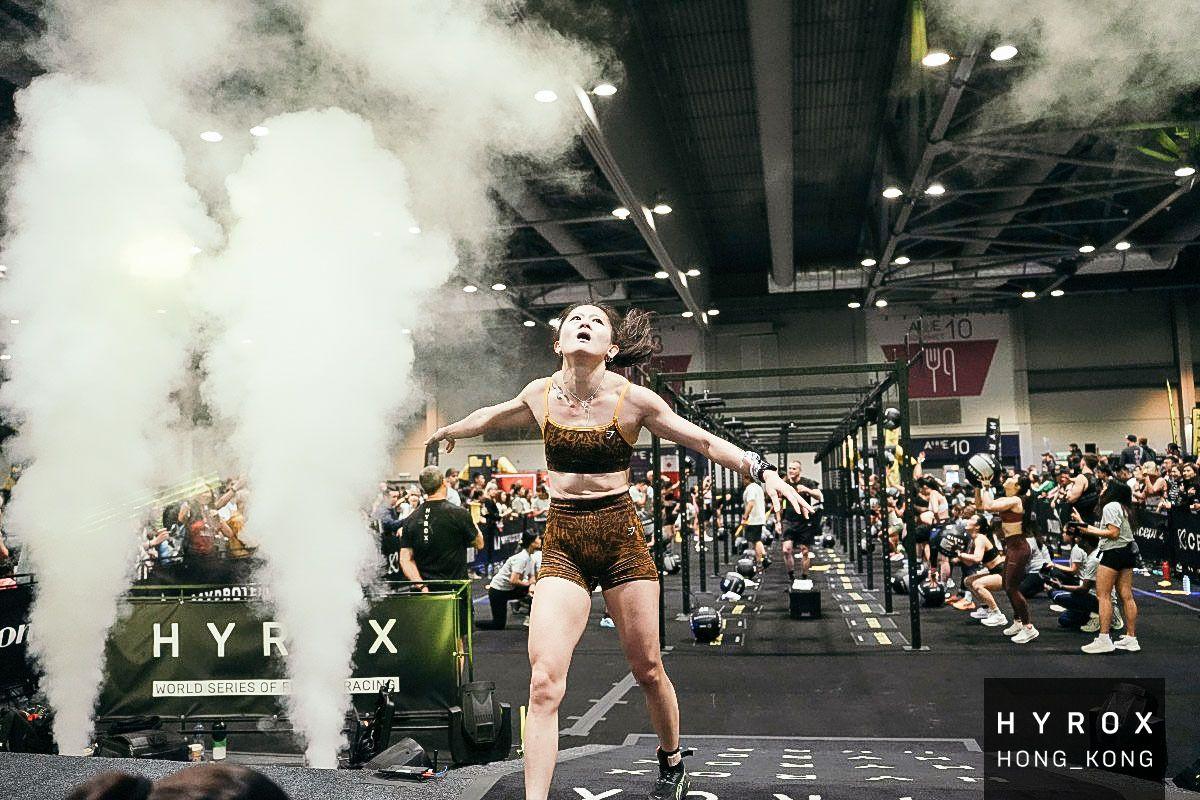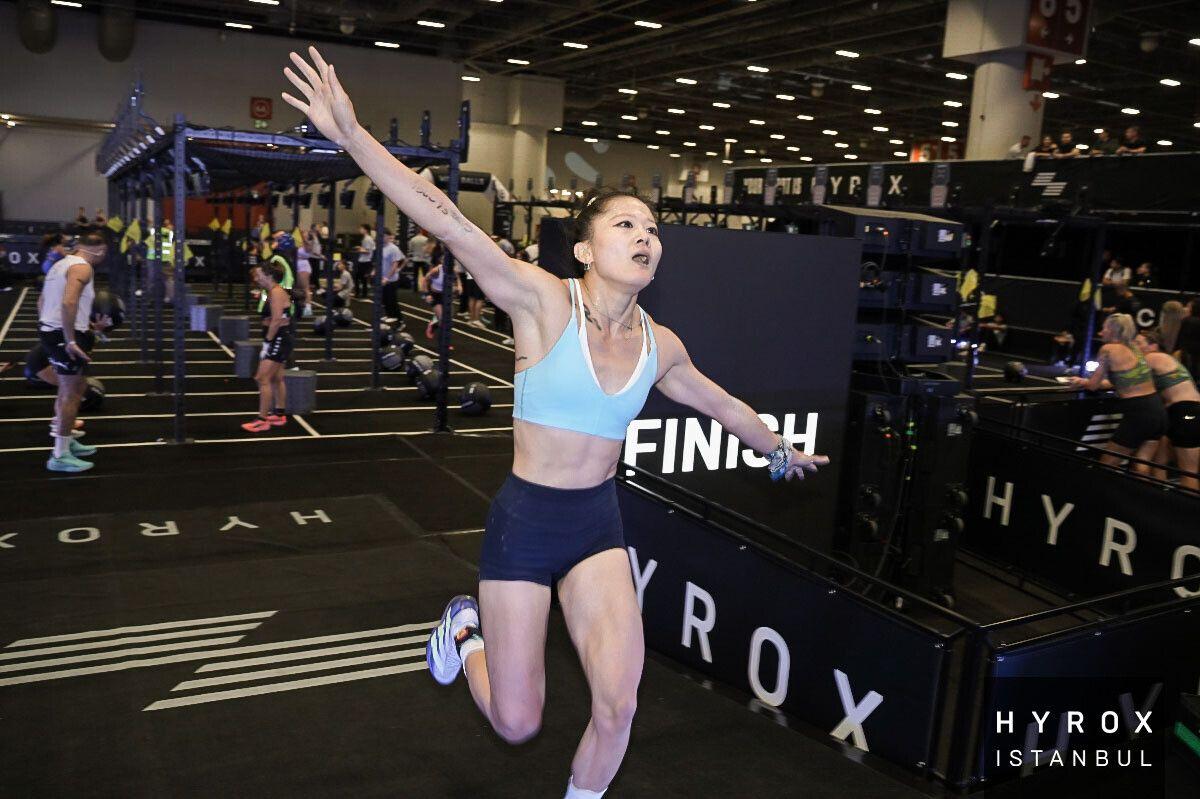
Hi everyone! I'm Pauline Yu (PYY), Taiwan's only 4× Hyrox World Championship qualifier. I still remember the first time I hit the wall ball station mid-race — not in training, but in an actual competition in Singapore back when the Asian Hyrox scene was just starting to explode. I had trained hard, felt confident going in, and then the moment I picked up that medicine ball and started throwing, my lungs just stopped cooperating. By rep 40 I was seeing stars. By rep 60 I was making deals with the universe. That experience taught me more about Hyrox wall balls than any training block ever could, and everything I'm sharing today comes directly from that hard-earned, slightly embarrassing, deeply humbling moment on the competition floor.
Key Takeaways
- ▸Wall balls are uniquely brutal in Hyrox because they combine a cardiovascular spike with full-body muscular fatigue simultaneously — understanding this dual demand is the first step to surviving all 100 reps without a catastrophic slowdown.
- ▸Your breathing pattern controls everything at this station: exhale sharply on the throw, inhale on the way down into the squat, and never hold your breath through the catch — doing so is the fastest route to dizziness and missed reps.
- ▸For women competing in the open division in Asia, the medicine ball is typically 4 kg, but elite women use 6 kg — confirm your division weight before race day so your training loads match your competition reality exactly.
- ▸Planned micro-breaks beat unplanned collapses every single time — set your break strategy before you pick up the ball, for example 20 reps, then 15, then 15, then 10, then 10, then 10, and stick to that plan even when you feel good early.
- ▸Wall ball technique in Hyrox rewards a wide squat stance and tall torso — a narrow, forward-leaning squat position collapses your chest into the ball, kills your throw power, and accelerates fatigue in your lower back and shoulders far sooner than necessary.
- ▸Training wall balls after a hard cardio effort — not fresh — is the only way to build the specific fitness needed for race day, because you will always arrive at this station with already-elevated heart rate and fatigued legs from the preceding ski erg or running segment.
Why Wall Balls Hit Different in a Race (My Honest Story)
Here's something nobody tells you when you first get into Hyrox: every station feels harder in a race than it does in training, but wall balls feel disproportionately harder. The reason is timing. In a standard Hyrox race, the wall ball station comes after you've already run at least 1 km, done your ski erg, another run, sled push, another run, sled pull, another run, burpee broad jumps, another run, rowing, another run, farmers carry, another run, sandbag lunges, and then one final run. By the time you're standing in front of that target, your cardiovascular system is nowhere near fresh. Your legs have already taken thousands of steps and absorbed the shock of loaded lunges. Your grip is cooked from the farmers carry. And now you have to throw a ball at a target 9 feet off the ground — for women's elite it's 9 feet — 100 times in a row. I learned this the hard way at my first major race in Asia, and I want to save you from going through the same shock.
The mental side of wall balls in Hyrox is also massively underestimated. When your heart rate is already sitting at 170-plus beats per minute from the run into the station, picking up the medicine ball and starting your first squat sends it even higher almost instantly. I've worn heart rate monitors in training and in races, and the wall ball station is consistently the point where I hit my peak heart rate — higher than burpee broad jumps, higher than the sled push, higher than anything else on the course. That's not unique to me; it comes up again and again when I talk to other women competing in Hyrox across Taiwan and the broader Asian region. Knowing that your heart rate is going to spike is actually empowering, because you can plan for it instead of panicking when it happens mid-set.
- ▸Practice wall balls specifically in a fatigued state by programming them at the end of a hard conditioning session — this teaches your nervous system and your lungs to manage the demand when you're already under stress, which is exactly the condition you'll face on race day.
- ▸Walk into the wall ball station with your breath already under control — spend the last 10 to 15 metres of your run before the station slowing your breathing deliberately, taking long exhales so your heart rate has even a small chance to come down before the first rep.
- ▸Never look at the total rep count on your counter when you're struggling mid-set — instead, focus only on the next five reps in front of you, because the brain processes small chunks far more manageable than the full number remaining.
- ▸Mentally rehearse the wall ball station during your race visualisation the week before competition — I do this the night before every single Hyrox event, running through what it will feel like at rep 50 when my arms are burning, and pre-deciding to keep my form and breathing locked in regardless.
The Technique Breakdown That Actually Keeps You Going
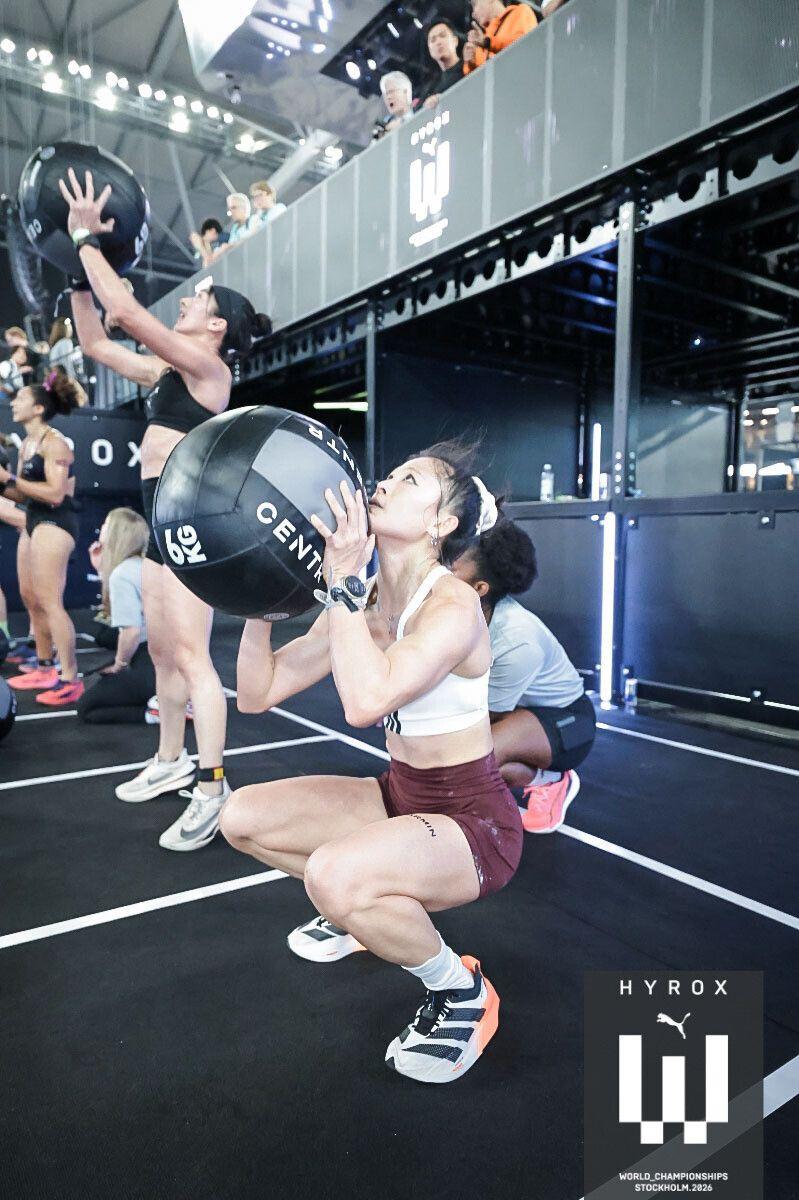
Let me walk you through exactly how I execute a Hyrox wall ball rep, because technique is the difference between cruising through 100 reps and grinding to a miserable halt at rep 70. Start with your feet slightly wider than shoulder width, toes turned out 15 to 30 degrees — this is your squat base, and it needs to be wide enough that your torso stays upright throughout the movement. Hold the ball at chest height, elbows pointed down, hands cupped underneath. As you descend into the squat, keep your chest tall and your eyes locked on the target marker on the wall. The moment you hit the bottom of your squat — don't pause, don't sink — drive through your heels explosively and transfer all of that power up through your hips, your core, and into your arms to launch the ball at the target. This is not a press. It's a full-body drive followed by a guide with the hands. The legs should be doing 70% of the work. If your shoulders are screaming by rep 30, your legs aren't contributing enough.
The catch is where a lot of athletes lose energy unnecessarily. When the ball comes back down, catch it softly with slightly bent elbows — absorb the weight rather than fighting it — and use the momentum of the ball dropping to load straight back into your next squat. This creates a rhythm, almost like a metronome, and that rhythm is your best friend during this station. I cue myself to breathe out as I throw and breathe in as I catch and descend. When that rhythm breaks — when I start holding my breath or breathing in shallow gasps — I know I need to take my planned rest break. Wall ball technique in Hyrox is as much about energy conservation through efficient movement as it is about raw strength or fitness. I've seen incredibly strong athletes from across Asia implode at this station because they were muscling the ball with their arms instead of using the whole kinetic chain.
- ▸Keep your elbows pointed down and inward throughout the movement rather than flaring them out to the sides — elbow flare reduces the power transfer from your body to the ball and causes your shoulders to tire out at a rate two to three times faster than they need to.
- ▸Use a squat depth that reaches parallel or just below — going deeper than necessary on every rep burns precious leg energy without adding any power to your throw, and at rep 80 you will feel every single extra inch you went down in reps 1 through 79.
- ▸Aim slightly above the target line rather than directly at it — this gives you a margin of error so that even if your throw loses a little height as you fatigue, you still make valid contact rather than having to redo reps and waste energy on corrections.
Race-Day Strategy and Pacing for Women's Elite Hyrox
Pacing strategy for the Hyrox wall ball station is something I genuinely wish someone had sat me down and explained in detail before my first women's elite race. There is a very specific trap that fast, fit athletes fall into at this station: they go out too hot in the first 20 reps because they feel strong, they burn their legs and lungs in those early reps, and then they spend the remaining 80 reps crawling through with terrible form and long unplanned rest breaks that cost them far more time than a conservative early pace would have. I have done this. I have watched competitors do this right next to me. The wall ball station rewards patience and punishes ego more ruthlessly than almost any other station in Hyrox.
My current race strategy for wall balls, refined across four World Championship appearances and countless races in Taiwan and across Asia, is built around pre-planned break points. I do not rest based on how I feel — I rest based on my predetermined split plan. Typically I go 25 reps, rest for three to five breaths standing with the ball resting on my chest, then 20 reps, rest three breaths, then 15 reps, rest three breaths, then three sets of 10 to finish. The early sets are deliberately conservative, and I hold back even when I feel like I could go faster. This approach means I finish the station with my form intact and my heart rate manageable, which directly translates to a faster run split out of the station. For women specifically, the ability to maintain form later in the set is a critical differentiator — I have passed multiple competitors in my age category simply by running out of the wall ball station at a decent pace while they were staggering.
- ▸Write your planned rep splits on your wrist or use a mental anchor word for each break point before you start — having the plan locked in prevents in-the-moment decision fatigue, which is very real when your heart rate is maxed out and your legs are burning.
- ▸During your rest breaks, do not let go of the ball and squat down to rest — standing with the ball at chest height keeps your body primed for the next set and your restart will be faster and smoother than if you fully drop out of the movement pattern.
- ▸In the final 15 to 20 reps, shift your focus entirely away from how your body feels and onto your exit — start mentally preparing to run well out of the station, because the competitor who runs well after wall balls gains huge chunks of time on the course.
What the Research Says
The science backs up a lot of what I've learned through hard experience on competition floors in Taiwan and around the world. Research published in the British Journal of Sports Medicine has consistently shown that compound movements performed under cardiovascular fatigue — exactly the condition we face at the Hyrox wall ball station — produce disproportionate increases in perceived exertion relative to actual mechanical workload. In plain terms: wall balls feel harder than they are on paper because your body is already stressed when you get to them. This is why training them fresh gives you an incomplete picture of your actual race readiness. Research in the Journal of Strength and Conditioning Research has also consistently demonstrated that athletes who train with pre-fatigued protocols — performing strength or skill work after cardio — show better performance retention in competition settings compared to athletes who only train movements in isolation. For my own training, this translated into a deliberate decision to never train wall balls as a standalone movement during competition prep. I always programme them after a run or a rowing effort so my body learns to execute the movement under the precise physiological conditions of a real Hyrox race. If you take one scientific principle away from this article, let it be that: train the fatigue, not just the movement.
Frequently Asked Questions
Q: What weight medicine ball do women use for Hyrox wall balls? A: In the open and pro women's divisions, the standard weight is 4 kg for wall balls in Hyrox. In the elite women's division, the ball is 6 kg. I would always recommend checking the specific division rules for the race you've registered for, because these details matter enormously for your training — if you've been training with 4 kg and you're racing elite with 6 kg, that difference will absolutely be felt at rep 60 of a fatigued set. I trained with 6 and 9 kg exclusively during my World Championship prep cycles, and I genuinely think that decision contributed to how I was able to maintain form late in the station at the world-level competition.
Q: How high does the target need to be for Hyrox wall balls? A: For women in Hyrox, the target height for wall balls is 9 feet, which is approximately 2.75 metres from the floor. For men, it's 10 feet. This is a standard Hyrox rule and it applies across all sanctioned events globally, including the events here in Asia and Taiwan that I've competed in. I'd strongly recommend training on a wall with a marked target at the correct height rather than guessing — throwing to the wrong height in training will mess with your natural throw mechanics and make the adjustment at race day feel awkward and unsettling right when you need everything to feel automatic and comfortable.
Q: I always gas out around rep 40 to 50 during wall balls — what am I doing wrong? A: Almost certainly one of two things, and I've experienced both personally. First, you're probably going too fast in your first 30 reps and burning your cardiovascular system before the set is halfway done — this is the most common mistake I see among athletes I coach in Taiwan. Second, you might be relying too much on your upper body and arms rather than driving the throw from your legs and hips. When your arms are doing the majority of the work, they fatigue extremely quickly, and that's usually what causes the wall around rep 40. Fix both by slowing your early pace, dropping into a wider squat, and consciously focusing on driving up through your heels on every single rep. It takes a few training sessions to rewire, but once it clicks the difference is dramatic.
Wall balls used to be the station I dreaded most. Now it's the one I feel most prepared for, and that shift came entirely from understanding the station deeply and training it with intention. I hope this breakdown saves you the painful education I had to go through myself. If you want more training content, race strategies, and honest insight from the Asian women's elite Hyrox world, come subscribe at paulineyuyu.com — I share new content regularly and I'd love to have you in the community. See you out there!
Sources: British Journal of Sports Medicine / Journal of Strength and Conditioning Research
Taiwan's elite HYROX Pro athlete and 4× World Championship qualifier. I share my training journey, race insights, and performance notes from the competition floor.