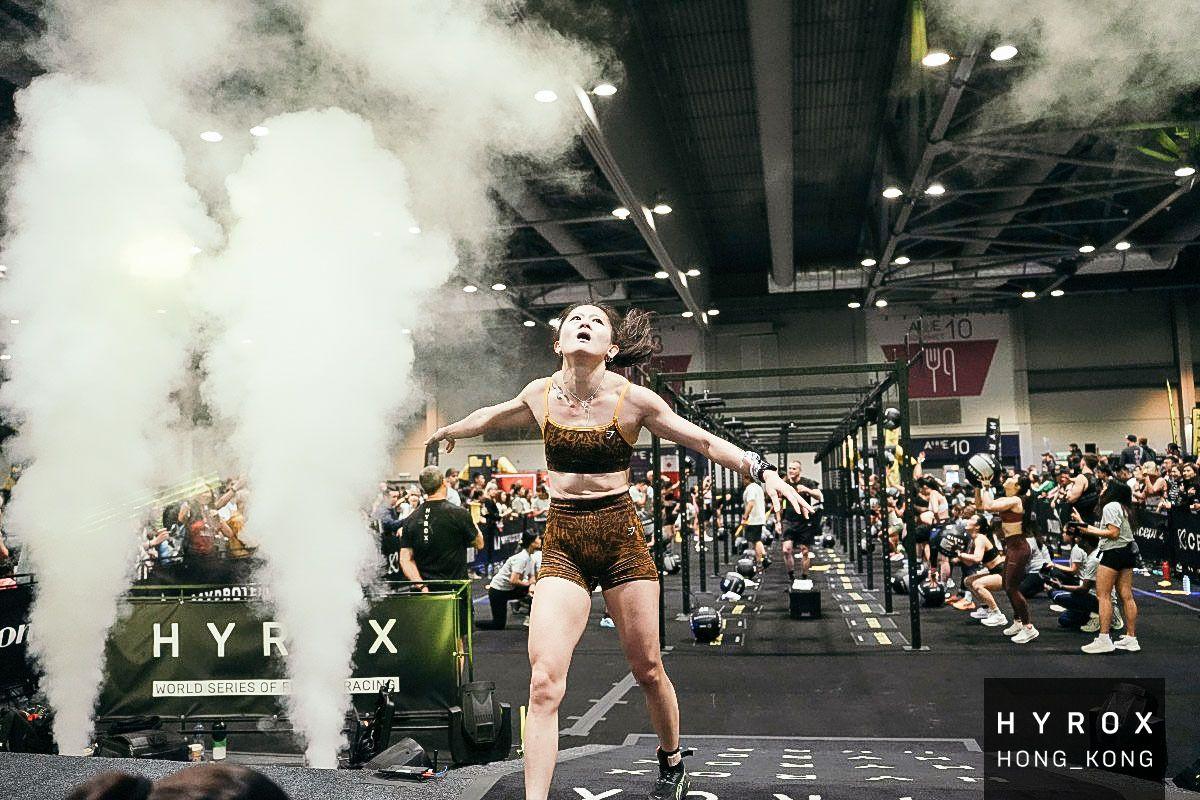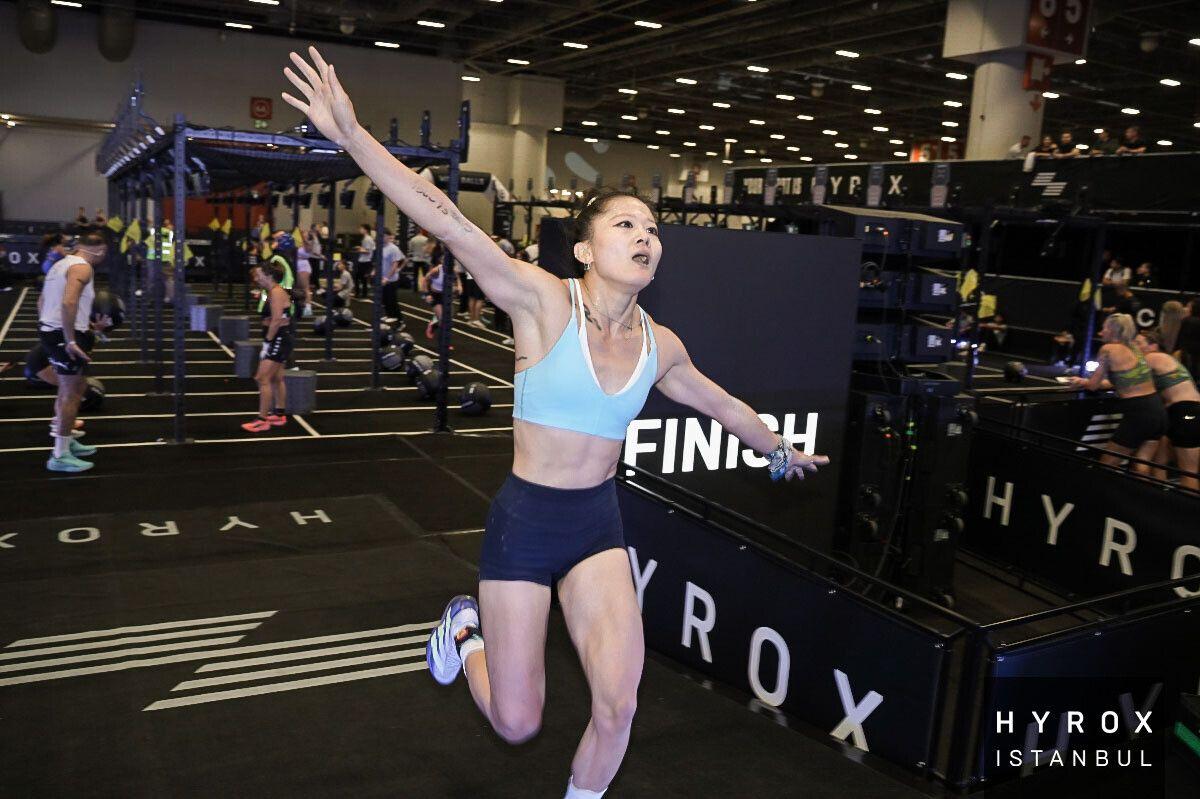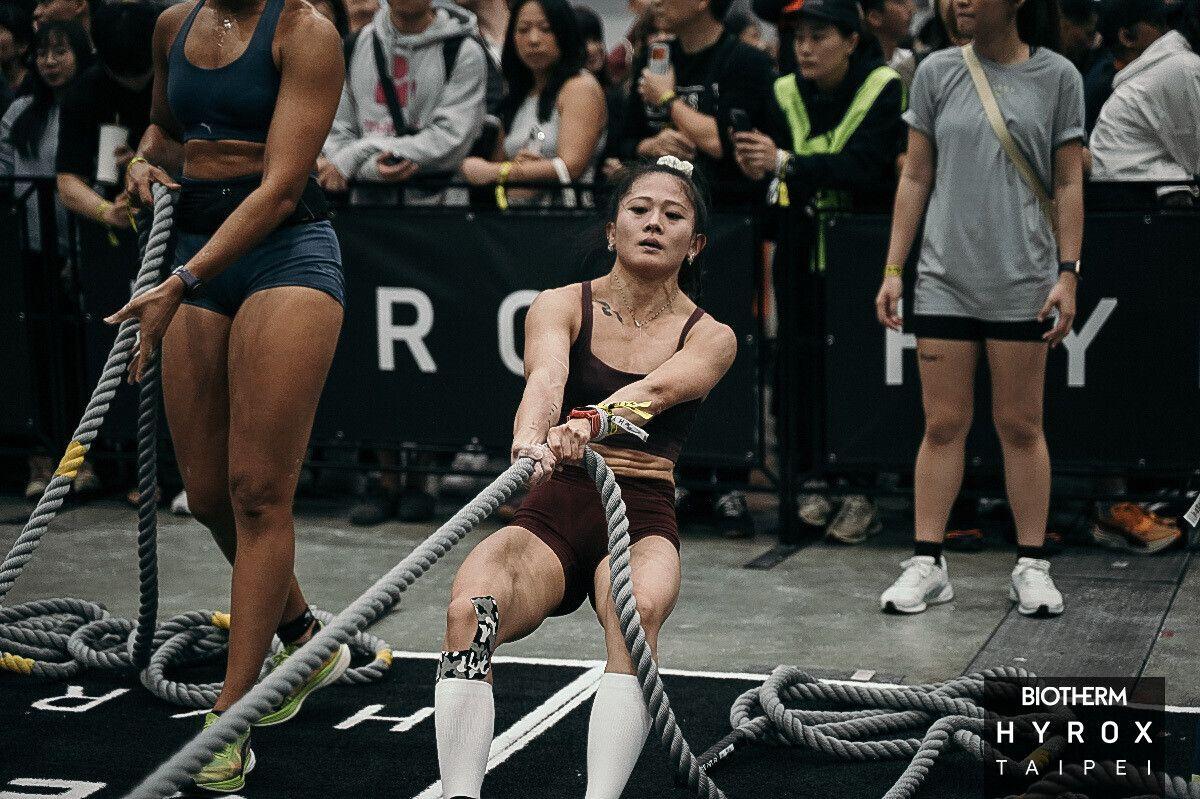
Hi everyone! I'm Pauline Yu (PYY), Taiwan's only 4× Hyrox World Championship qualifier. I still remember the first time I stood behind a loaded sled at a Hyrox race in Europe and thought — okay, this is the moment everything either holds together or falls apart. My legs were already burning from the ski erg and the 1 km run that preceded the sled push, and I made every rookie mistake in the book: I stood too tall, pushed with my arms instead of driving with my hips, and I basically crawled that 50 metres. I finished the station humiliated and with legs so wrecked that my next run split was a disaster. That one bad experience sent me deep into a rabbit hole of technique work, and what I discovered completely changed how I race. The sled stations — both push and pull — are now genuinely two of my favourite moments in a Hyrox race, and I want to share everything I've learned so you can feel the same way.
Key Takeaways
- ▸A low, aggressive body angle on the sled push — roughly 45 degrees or less — transfers far more force into the sled and dramatically reduces the quad and calf fatigue that wrecks your running splits afterward.
- ▸Drive with your hips and glutes, not your arms — your upper body stabilises the push, but the real power comes from a strong, rhythmic leg drive where each step is short, fast, and purposeful.
- ▸On the sled pull, keep the rope low and close to your centre of gravity, walk backward with steady tension, and avoid jerking — smooth continuous tension is faster and kinder to your grip and forearms.
- ▸Pacing strategy matters enormously for women's elite Hyrox: do not sprint the first 10 metres of either station — settle into your sustainable power output within the first three steps and hold it all the way through.
- ▸Train the sled stations at race weight regularly in preparation, and always pair them with a 200–400 m run immediately after so your body learns to transition from heavy load to running mechanics without shutting down.
- ▸Breathing rhythm during the sled push is often overlooked: exhale on each push step and maintain a consistent pattern — holding your breath even for a few seconds under load spikes your heart rate unnecessarily and costs you time on the next run.
Why I Used to Fear the Sled — And How I Stopped
When I first started training seriously for Hyrox here in Taiwan, the sled felt like punishment. I'd watch videos of elite athletes in Europe and the US absolutely flying through the sled push, and I couldn't understand how they made it look so effortless. I was training with a relatively light frame — which is common for women competing in Asia — and I assumed the sled would always be my weakness because of body weight and raw strength. What I didn't understand yet was that sled efficiency is almost entirely about technique and body mechanics, not about how much you can squat or how heavy you are. The first time a coach watched me push and pointed out that I was standing nearly upright, I honestly didn't believe that posture could make such a massive difference. But after one session where I deliberately kept my chest almost parallel to the ground and focused on short, powerful strides, the sled started moving faster and my legs felt less destroyed afterward. That was the single biggest shift in my Hyrox performance in terms of a station-specific breakthrough.
Here's what I tell every athlete I coach in Taiwan when they come to me frustrated with the sled push: think of yourself as a sprinter in a starting block, not an upright runner. Your entire body should be one long lever driving force horizontally into the turf and through the sled. When you stand tall, gravity is working against you and your quads are doing all the work to keep you from falling forward — that's exactly the muscle group you need fresh for the next 1 km run. The moment you lower your angle of attack, you recruit your glutes, hamstrings, and posterior chain, which have far more endurance capacity. This is a game-changer for women's elite Hyrox competition, where the difference between the podium and top ten often comes down to how well you manage your legs across all eight stations and the runs in between. I've seen athletes with incredible running times lose significant ground because they came out of the sleds with completely blown quads, and I've seen others who aren't the fastest runners make up real time by coming out of the sleds fresh enough to maintain their pace. That's the entire game with the sled.
- ▸Set your body angle before you even start moving — take one breath, drop your hips back slightly, lean your torso forward so your chest faces the floor, and only then begin your first drive step, because starting tall means you'll stay tall for the whole 50 metres.
- ▸Keep your steps short and quick rather than long and lunging — long strides under a heavy sled load slow you down and force your quad to work eccentrically under load, which is exactly the kind of fatigue that lingers for three or four stations afterward.
- ▸Squeeze your glutes actively with every single step — it sounds simple but most athletes forget this completely under race stress, and engaging your posterior chain not only adds power but also protects your lower back from the shear forces involved in sled pushing.
- ▸Keep your arms and hands relaxed on the handles — a death grip or locked elbows transfers tension up through your shoulders and neck, wasting energy and creating unnecessary upper body fatigue that compounds across a full Hyrox race of eight stations and eight runs.
Mastering the Sled Pull: The Station Most Athletes Underestimate
The sled pull gets far less attention than the push in most Hyrox training content, and that's a mistake. In my experience competing across Asia and at the World Championships, the pull actually catches more athletes off guard than the push does, because it's a movement pattern that feels awkward and unfamiliar — especially for women who haven't done much loaded backward walking or rope-based pulling work in their regular training. The Hyrox sled pull requires you to walk backward for 25 metres while pulling the rope hand over hand to drag the sled toward you, then turn around and walk 25 metres forward pulling the rope back in the other direction. The weight for women in the open category is lighter than the push, but in the elite pro division the load is significant, and grip fatigue, shoulder fatigue, and the disorientation of walking backward under load all compound quickly if you haven't specifically trained for it. The first time I competed at an international Hyrox event, I underestimated this station completely. I went in hot, tried to pull as fast as possible, and by the halfway point my forearms were pumped and my grip was fading. I had to slow down to a crawl for the second half, and I lost almost 20 seconds I should never have lost.
What I learned from that experience — and from dozens of training sessions specifically targeting sled pull mechanics — is that the pull is a game of tension management, not maximum effort. You want to keep the rope at a low angle, almost parallel to the ground, so the pulling force is as horizontal as possible. The moment you let the rope angle upward steeply, you're fighting gravity instead of leveraging it, and the rope starts to act more like a cable machine than a sled pulling implement. I also learned to walk backward with a wide, stable stance and deliberate heel-to-toe footwork rather than quick shuffled steps, because a wider base gives you a more stable platform to generate pulling force. Your back should be slightly rounded in a strong braced position — think of the same brace you'd use for a Romanian deadlift — and your pull should come from a big, fluid arm-over-arm motion that engages your lats and biceps together, not just your hands and wrists. These adjustments took me from struggling with the pull to treating it as a station where I can genuinely make up ground on my competitors, which is a completely different mindset.
- ▸Keep the rope as horizontal as possible throughout the pull — a low rope angle maximises horizontal force transfer to the sled, reduces wasted energy fighting rope sag, and keeps your pulling mechanics clean and repeatable across the full 50-metre distance.
- ▸Practise the backward walk specifically in training — it sounds obvious but many athletes only train the rope pull without the backward locomotion component, and the combination of pulling under load while walking backward is a completely different neuromuscular challenge that must be trained intentionally.
- ▸Protect your grip by using an alternating hand pull pattern with relaxed fingers between each pull — if you white-knuckle the rope from the start, your forearms will fail before the sled is halfway to you, and recovery time for grip fatigue during a race is essentially zero.
Race Strategy for Both Sled Stations: The Details That Separate Podium from Pack
Understanding technique is one thing — applying it under race stress when your heart rate is through the roof and you've already run several kilometres is a completely different challenge. I've competed in enough Hyrox races across Taiwan and internationally to know that athletes almost always regress to their least trained movement patterns under pressure. That means whatever bad habits you have in training — standing too tall on the push, death-gripping the rope on the pull, holding your breath — they will be amplified tenfold on race day. So the training approach I use and recommend is what I call stress-inoculation training: you practise the sled stations specifically when you're already pre-fatigued, either by doing them mid-workout after running intervals or by pairing them with the exercises that precede them in a real Hyrox race. In Taiwan, where I do most of my training, I'll often set up a simulation workout where I do a ski erg interval, then a 1 km run at race pace, then go straight into sled push — and only then do I get any rest. This forces my nervous system to access clean sled technique even when everything in my body is screaming.
Another piece of race strategy that I think gets almost no coverage in generic Hyrox content is the transition into and out of the sled stations. The 5 to 10 seconds you spend positioning yourself at the start of the sled push — getting your hands set, checking your stance, taking one controlled breath — are seconds you'll absolutely get back through a cleaner, faster execution. I've seen athletes sprint up to the sled in a panic and start pushing before they've even set their grip properly, and they end up losing time because the first 10 metres are sloppy and inefficient. On the back end of the station, the transition back to running after both sled stations is where smart pacing during the station pays off. If you've executed the push and pull correctly and preserved your legs, you should be able to pick up to 80 or 90 percent of your normal running pace within the first 100 metres after the station. If your quads are wrecked, you'll be shuffling and losing time to athletes who were technically smarter, even if they're slower runners overall. This is particularly important in women's elite Hyrox, where the overall race time margins can be very tight and every second genuinely counts.
- ▸Use the first two to three steps of the sled push to find your rhythm rather than trying to go full power immediately — a controlled, progressive build into your working pace is almost always faster over the full 50 metres than an explosive start that degrades into a shuffle halfway through.
- ▸Practise your post-sled running transition at least once per week — this means finishing the sled push or pull in training and immediately breaking into a run, because your body needs to learn how to recruit running muscles after a heavy pulling or pushing effort without a rest period in between.
- ▸Know your own sustainable power output on the sled before race day — time yourself over the 50 metres in training at different effort levels and find the pace that leaves your legs functional, then commit to that pace in the race regardless of what the athletes around you are doing.
What the Research Says
The principles behind efficient sled pushing and pulling are deeply grounded in sports science. Research published in the Journal of Strength and Conditioning Research has consistently shown that horizontal force production — the ability to drive force into the ground in a forward direction rather than purely vertical — is a critical determinant of speed and power output in loaded locomotion tasks. This is exactly why body angle matters so much in the Hyrox sled push: a lower, more horizontal position allows you to direct your force where it actually moves the sled, rather than wasting energy fighting gravity. Additionally, research in the British Journal of Sports Medicine has highlighted the significant role of posterior chain engagement in reducing anterior knee stress during heavy lower-body efforts. In practical terms, this means that using your glutes and hamstrings rather than your quads as the primary power source during the sled push isn't just more efficient — it's also significantly less damaging to your legs for the remainder of the race. I've felt this difference personally in every race where I've implemented it. On days when my technique is clean and my posterior chain is doing its job, I step off the sled station feeling like I've barely touched my legs. On days when stress causes me to regress to a more upright, quad-dominant position, I can feel the difference immediately in my next run split. The science and the lived experience point in exactly the same direction, and that's as good a reason as any to trust the technique work.
Frequently Asked Questions
Q: How heavy is the sled for women in Hyrox, and does it change between categories? A: Yes, the weight differs by category. In the Hyrox Women open category, the sled push is typically performed at a lighter load than the men's, and in the Pro Women category the load increases significantly. I compete in the Pro Women division, which means I train with the heavier load year-round. My honest advice is to always train at or above your race-day weight so that race day feels relatively manageable by comparison. If you're a new Hyrox athlete in Taiwan or anywhere in Asia, start by confirming the exact weights for your specific category on the official Hyrox website, because they have been updated over the years, and going into race day uncertain about the load is an unnecessary source of anxiety.
Q: Should I train the sled push and pull separately, or always together? A: In my training programme, I do both. Early in a training block I isolate them to work on specific technique issues without the fatigue variable complicating things. But as race day approaches, I always combine them in simulation workouts that mirror the actual Hyrox race structure — meaning I do them in sequence with runs in between, just like they appear in the real event. The sled pull comes after the sled push in a Hyrox race with a run between them, and your body needs to experience that specific sequence under fatigue to adapt properly. Isolated training builds the skill; combined training builds the race-specific fitness and mental confidence to execute under pressure.
Q: My grip fails on the sled pull before I finish the station — what can I do about this? A: This is one of the most common issues I hear from women new to Hyrox, especially in Asia where a lot of athletes come from a running background and haven't built much grip strength. The honest answer is twofold: first, you need to deliberately train grip strength as a standalone quality — farmer's carries, dead hangs, rope climbing or rope pulling exercises should all be in your programme. Second, you need to review your pulling technique, because a jerky, aggressive pull pattern fatigues the forearms much faster than a smooth, controlled one. I train my grip twice a week outside of my main Hyrox sessions, and when I switched to a more fluid pulling rhythm on the sled, my grip failure problem essentially disappeared. Give it six to eight weeks of consistent work and you'll feel a significant difference.
The sled stations used to be the part of Hyrox I dreaded — now they're where I know I can make up time and separate myself from the field. I hope everything I've shared here gives you the same confidence I eventually found after years of trial, error, and a lot of heavy sleds. If you want more training tips, race breakdowns, and honest first-person content from my journey as a Taiwanese women's elite Hyrox athlete, come and subscribe at paulineyuyu.com — I share things there that I don't post anywhere else, and I'd love to have you along for the journey. See you at the start line!
Sources: British Journal of Sports Medicine / Journal of Strength and Conditioning Research
Taiwan's elite HYROX Pro athlete and 4× World Championship qualifier. I share my training journey, race insights, and performance notes from the competition floor.