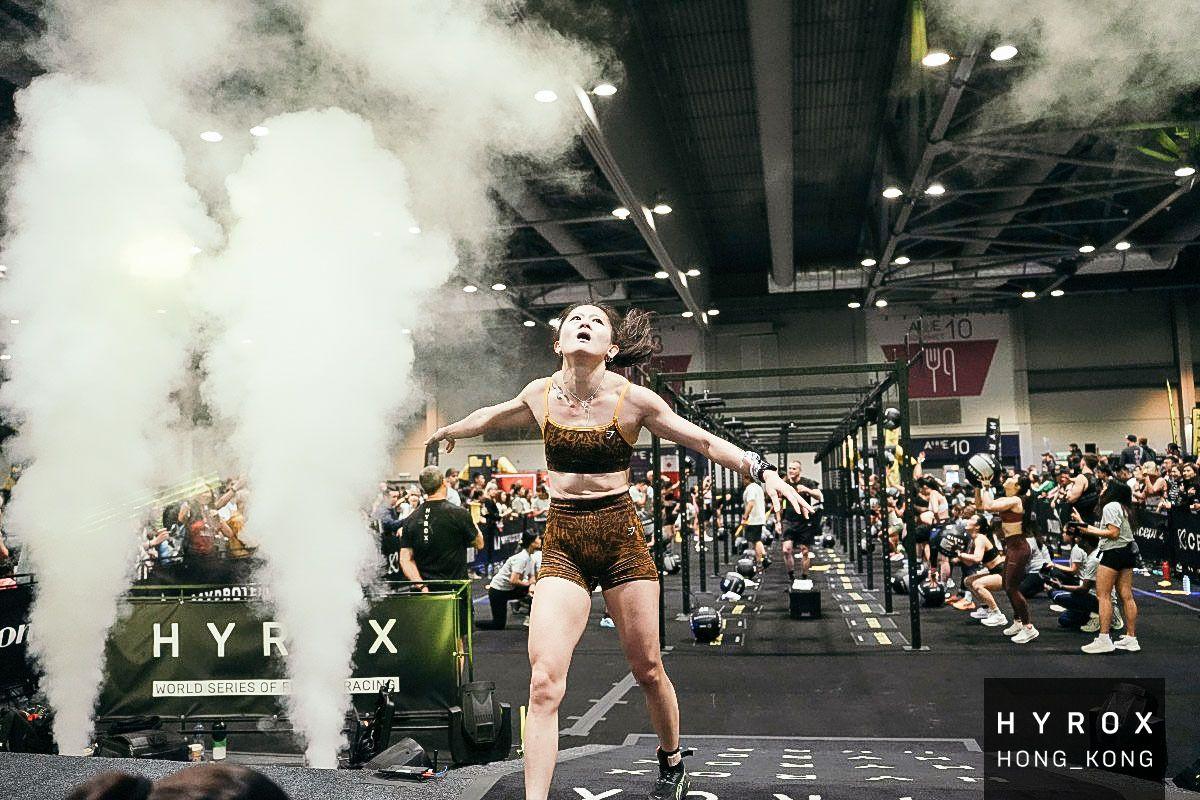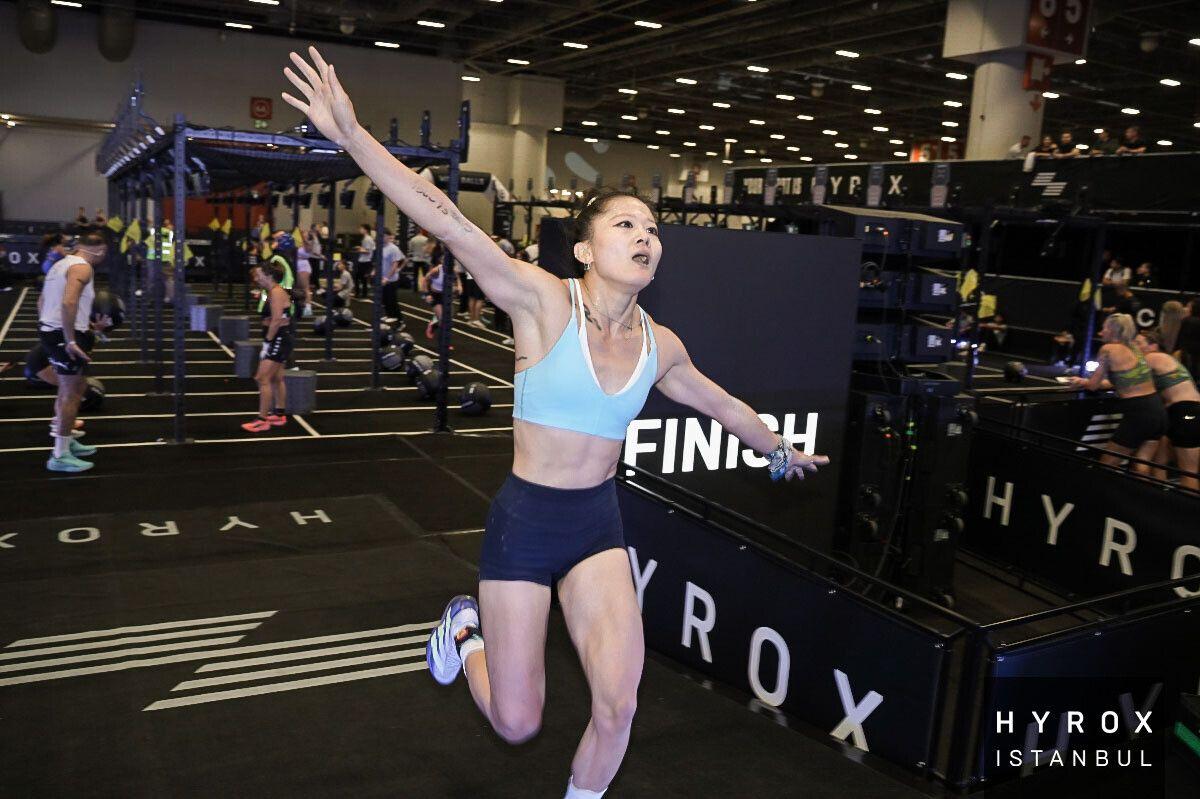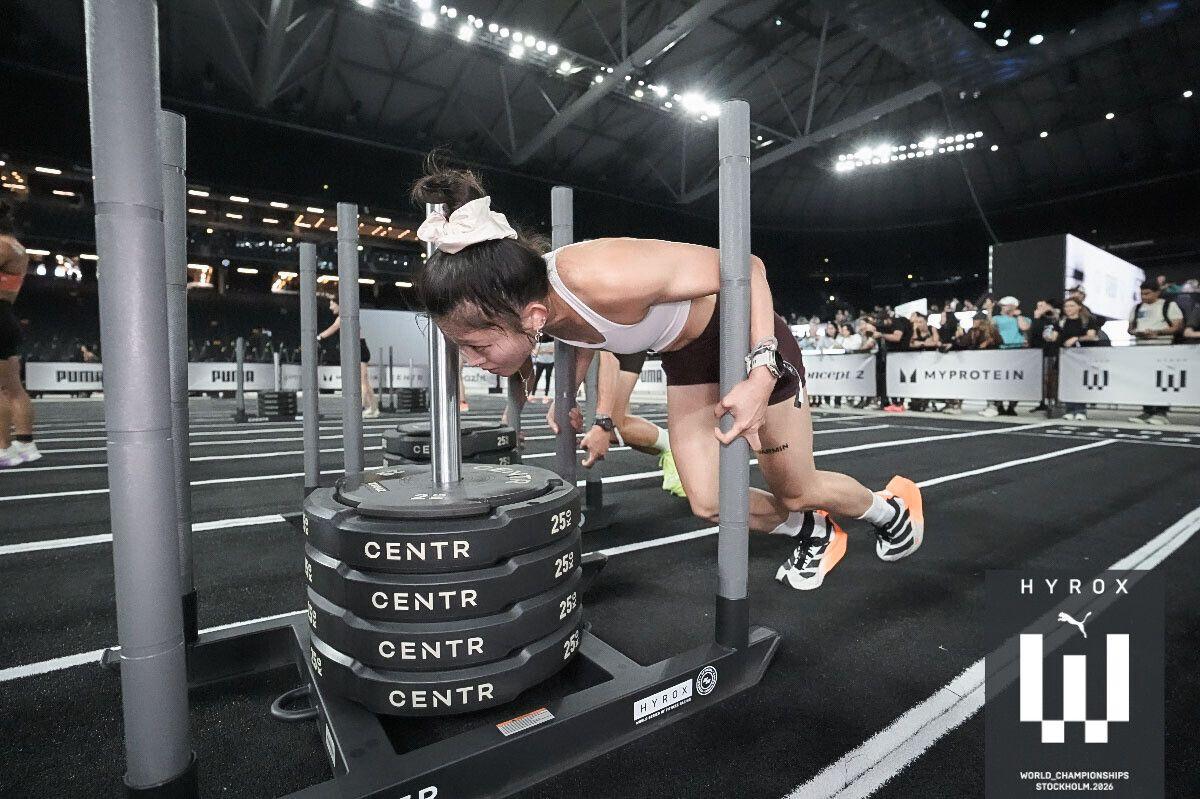
Hi everyone! I'm Pauline Yu (PYY), Taiwan's only 4× Hyrox World Championship qualifier. The first time I ever attempted a Hyrox sled push in a real competition setting, I was completely blindsided — not by the weight, but by how fast my lungs gave out before my legs did. I remember hitting that second sled lane in Hamburg and thinking, why does this feel so different from training? My hips were too high, I was pushing through my arms instead of my legs, and I'd chosen a load that sounded impressive on paper but was absolutely destroying my transition time into the next station. That race taught me more about the sled push than any single training block ever had. Since then, I've spent years refining my approach specifically as a woman competing at the elite level in Taiwan and across Asia, and I want to share every hard-won detail with you.
Key Takeaways
- ▸For women in the Open category, the Hyrox sled push weight is 102 kg total — choosing to treat that as 'light' and sprinting recklessly will spike your heart rate and wreck your pacing for the remaining stations, so always push with controlled aggression rather than panic.
- ▸Your hips should sit lower than you instinctively want them to — a 45-degree body angle allows you to drive force through your legs and into the sled rather than losing energy upward into the air, which is the single most common technical mistake I see among women new to this station.
- ▸Short, powerful strides win the sled push — taking long, lunging steps breaks your contact rhythm with the floor and causes the sled to stutter, adding precious seconds to your time that compound badly in a race that already demands so much from your body.
- ▸Breathing strategy matters enormously: exhale sharply on each push step rather than holding your breath, because breath-holding raises intra-abdominal pressure unproductively and accelerates the feeling of cardiovascular collapse before you reach the turnaround point.
- ▸Training the sled push at competition weight for sustained efforts of 25 metres or more — rather than short heavy singles — is what actually transfers to race performance, and I'd argue most women in Asia are undertrained specifically on this extended-effort version of the movement.
- ▸Recovery between the sled push and the next station is a skill you can practise: walking the transition briskly while bringing your breathing down, rather than standing still and gasping, keeps your cardiovascular system in a more recoverable zone and protects your overall race time.
Why Women Lose So Much Time on the Sled Push (And How I Fixed My Own)
Let me be brutally honest about something I got wrong for the first two years of my Hyrox career. I assumed the sled push was just a strength problem. I thought if I could squat more, deadlift more, and build stronger glutes, the sled would just move faster. And yes, absolute strength matters — I'm not going to pretend otherwise. But the truth is that most of the time women lose to men on this station, it's not purely about how much they can lift in the gym. It's about how efficiently they translate force into horizontal movement under cardiovascular fatigue, while maintaining a technically sound position, across a full 25-metre push. I've watched incredibly strong women — women who outperform men on the rowing segments and the ski erg — slow to a crawl on the sled because their technique broke down the moment their heart rate spiked above threshold. That used to be me. Training in Taiwan, where functional fitness culture was still growing rapidly when I started competing, I didn't have easy access to sled-specific coaching, so most of my early errors went uncorrected for longer than I'd like to admit.
The fix, when it finally clicked for me, was actually quite simple in concept even though it took time to groove into muscle memory. I started filming every single sled push session from the side, and watching the footage back within minutes of finishing. What I saw shocked me: my hips were creeping upward as I fatigued, turning my body into an almost vertical line, which meant I was pushing down into the ground instead of driving horizontally into the sled. The sled wasn't moving efficiently — I was working twice as hard for half the output. Once I committed to keeping my torso at a low angle and my arms locked as a rigid connection between my body and the handles, everything changed. My times dropped. My heart rate at the finish of the station actually came down, because I was doing less wasted work. This is the kind of detail that separates women competing at elite Hyrox level from those who plateau in the middle of the field, and it's completely available to anyone willing to put in deliberate, filmed practice sessions.
- ▸Film yourself from the side during every sled push training session and review the footage immediately — look specifically for hip rise as you fatigue, because that is the first and most damaging technical breakdown for almost every female athlete I've ever coached or trained alongside.
- ▸Lock your arms and treat them as rigid connectors rather than active pushers — your legs generate the power, your arms simply transmit it, and any bend in the elbow during the push means you are absorbing force rather than transferring it to the sled.
- ▸Set a visual marker at the midpoint of each 25-metre lane during training and make a conscious technical check every time you pass it — hips low, arms straight, chest forward, short quick steps — because the midpoint is exactly where technique tends to collapse under real fatigue.
- ▸Practice transitioning directly from a high-heart-rate movement like the ski erg or rowing machine into your sled push without rest, because replicating that pre-fatigued state in training is the only way to build the technical resilience you need on race day when everything feels harder than expected.
Load Selection Strategy: What Weight Should Women Actually Use in Training?
This is probably the question I get asked most often by women in the Hyrox community across Taiwan and the wider Asia region — what weight should I be training with? And I understand why it's confusing, because the answer is not simply 'use competition weight every session.' The official Open women's weight is 102 kg, and the Pro women's weight is 102 kg as well for the sled push — I want to be precise about this because I've seen a lot of misinformation circulating online. When I was preparing for my first World Championship qualifier, I made the mistake of ego-loading my sled in training. I wanted to feel tough. I wanted to prove something to myself. So I added extra plates, pushed uncomfortably heavy loads, and convinced myself that if I could move something heavier in the gym, competition weight would feel easy. What actually happened was the opposite: I developed compensatory movement patterns to handle the excess load, which hardwired bad mechanics into my nervous system, and those bad mechanics showed up on race day under the exact conditions — fatigue, adrenaline, crowd noise — when I needed clean technique the most.
The smarter approach, which I now use myself and recommend to every woman I train with, is to periodise your sled load just like you would any other strength training variable. Early in a training block, use 70 to 80 percent of competition weight and focus entirely on technique — low hips, fast feet, locked arms, consistent breathing. As you move toward race day, build toward full competition weight for sustained efforts. In the final two to three weeks before a race, I like to do race-simulation sets at exactly 102 kg for the full 25-metre push, with the kind of pre-fatigue load I'd expect from the preceding station. This gives your body a true preview of race conditions and removes the psychological fear of the weight on race day. Women who train this way consistently — and I've seen this across training groups in Taiwan and in conversations with elite women from other parts of Asia — perform significantly more confidently on the sled in competition than those who either avoid heavy loads or overload without structure.
- ▸Periodise your sled load in three phases: technique focus at 70-80% of race weight, strength-endurance development at 85-95%, and race-simulation work at exactly competition weight — rushing to heavy loads too early costs you the technical foundation that holds everything together under fatigue.
- ▸Never skip the deload week before a race by cramming in extra heavy sled sessions — your nervous system needs to be fresh on race day, and the fitness you built in the preceding eight to twelve weeks is what will carry you through the station, not a last-minute heavy session two days before the gun goes off.
- ▸If you have access to different floor surfaces during training, use them deliberately — sleds move faster on smooth competition floors than on rough gym turf, so training exclusively on one surface may leave you surprised on race day, and adjusting your stride cadence slightly for the surface is a skill worth developing in advance.
Race-Day Tactics: How to Narrow the Gap Against Men and Beat Your Own PR
Here's something I think about a lot as one of the only women from Taiwan competing consistently at the Hyrox World Championship level: the gap between women and men on the sled push is real, but it's not fixed. It's not purely biological. A significant portion of that gap is tactical and technical, and that means it's trainable. When I watch elite men push the sled, what stands out isn't just that they're stronger — it's that they rarely break their rhythm. They find a pace they can sustain, they lock into it, and they grind through the full distance with no dramatic slowdowns. The best women I've competed against do exactly the same thing. They're not trying to match men's absolute speed — they're executing their own optimal pace with perfect consistency. That mental shift — from 'push as hard as possible' to 'maintain my best sustainable pace' — was genuinely transformative for my own race results and it's something I try to communicate to every female athlete I speak to about this station.
On race day specifically, your sled push pacing strategy needs to account for what came before it and what comes after it in the Hyrox race format. The sled push is station number five in the standard Hyrox race order, which means by the time you reach it, you've already completed a 1 km run, rowing, ski erg, sled pull, and burpee broad jumps — your legs are not fresh, your lungs are working hard, and your ability to make good technical decisions under pressure is being tested. This is exactly why drilling the technique until it's automatic matters so much. When I'm deep in a race and my conscious brain is occupied with managing discomfort and pacing, I need my body to default to the correct position without me having to think about it. That automaticity only comes from thousands of repetitions done correctly in training. For women competing in Taiwan and across Asia who want to genuinely close the gap to their male counterparts, the investment is in quality, consistent, technically demanding sled push training — not just more volume, but smarter volume.
- ▸Know your target split before the race starts — calculate how long your sled push should take based on your training times and factor it into your overall race plan so you're not guessing on the day and either redlining too early or leaving time on the table by going too conservatively.
- ▸Use the 1 km run immediately before the sled push station to begin your mental preparation — visualise your body position, your foot cadence, and your breathing pattern during the final 200 metres of that run so you arrive at the handles already focused and ready rather than scrambling to shift mental gears at the last second.
- ▸If you start to lose form mid-push, a single verbal cue said out loud or in your head — something like 'hips down' or 'drive through' — can interrupt the technical breakdown and reset your position, and I genuinely use these self-cues in competition because they work far better than trying to consciously reconstruct your technique under extreme fatigue.
What the Research Says
The science strongly supports what my own competition experience has shown me about resisted sled training. Research in the Journal of Strength and Conditioning Research has consistently shown that horizontal force production — the kind demanded by a sled push — is a distinct quality from vertical force production, and that athletes who train specifically for horizontal force expression outperform those who rely solely on traditional squat and deadlift patterns when it comes to accelerating external loads. This is really important for women to understand, because so many of us spend the majority of our gym time on vertical movements. We deadlift, we squat, we hip thrust — all valuable, all necessary — but they don't fully transfer to the horizontal demands of a sled push without supplementary training in that specific movement pattern. Additionally, research published in the British Journal of Sports Medicine examining fatigue and performance in functional fitness competition formats has highlighted that cardiovascular efficiency under sustained mechanical load is a primary limiting factor for performance — not just peak strength. In practical terms, this means that your ability to keep your heart rate from spiking uncontrollably during the sled push depends as much on the efficiency of your technique as it does on your cardio fitness. Clean mechanics reduce the oxygen cost of the movement. That's exactly why the body position and stride rhythm details I've described above aren't just aesthetic preferences — they have a direct physiological impact on how hard this station feels and how fast you get through it.
Frequently Asked Questions
Q: How heavy is the sled push for women in Hyrox Open? A: The women's Open sled push weight is 102 kg total in Hyrox competition. This is the combined weight of the sled and the plates loaded onto it. When I first started competing, I was honestly nervous about this number — it sounds like a lot, especially if you're newer to strength training. But I promise you that with correct technique, particularly the low hip position and leg-driven force production I've described throughout this article, 102 kg is very manageable for a trained woman. The key is not to think of it as a max-effort lift but as a sustained-effort push that you need to execute smoothly across 25 metres while already fatigued from prior stations. Build up to it gradually in training, film your technique, and by race day it should feel familiar and controlled rather than scary.
Q: Should I wear lifting shoes or running shoes for the sled push? A: This is a great question and one I've experimented with personally over multiple competition cycles. I always race in running shoes because Hyrox is fundamentally a running race and the compromises of switching footwear between stations aren't worth it for most athletes. That said, I've noticed that a shoe with a slightly firmer sole gives better force transmission during the sled push than a super cushioned maximalist trainer — too much cushion absorbs the drive you're trying to send into the ground. In training, I sometimes use a flat cross-training shoe specifically for sled work so I can feel the ground contact more clearly. On race day, a well-fitted running shoe with moderate cushioning is your best all-around choice, and I'd prioritise fit and familiarity over any specific sled-push optimisation.
Q: How do I train the sled push if my gym doesn't have a sled? A: This was genuinely my reality for part of my training life in Taiwan before functional fitness gyms became more widely available. The best alternatives I've found are: heavy prowler pushes if available, plate pushes on a smooth floor using a weight plate directly on the surface (works surprisingly well), and loaded carry variations like heavy farmer carries and yoke walks that develop the same hip-stabilising muscles and cardiovascular response. Of these, the plate push on a smooth floor is the most specific substitute and I still use it occasionally when I'm travelling. I'd also strongly recommend seeking out any gym within travelling distance that does have a sled and scheduling dedicated sessions there even if it's not your regular training facility — the specificity is genuinely worth the commute.
The sled push is one of those stations that rewards patience and process. It took me multiple World Championship cycles to truly understand it, and every small improvement I've made has come from honest self-assessment, deliberate practice, and a willingness to prioritise technique over ego. If you're a woman working toward your first Hyrox race, or a seasoned competitor trying to shave seconds off your station time, I hope this guide gives you something concrete to work with. You've got this. Come find more training content, race prep guides, and personal updates from my competition journey at paulineyuyu.com — I'd love to have you as part of the community.
Sources: British Journal of Sports Medicine / Journal of Strength and Conditioning Research
Taiwan's elite HYROX Pro athlete and 4× World Championship qualifier. I share my training journey, race insights, and performance notes from the competition floor.