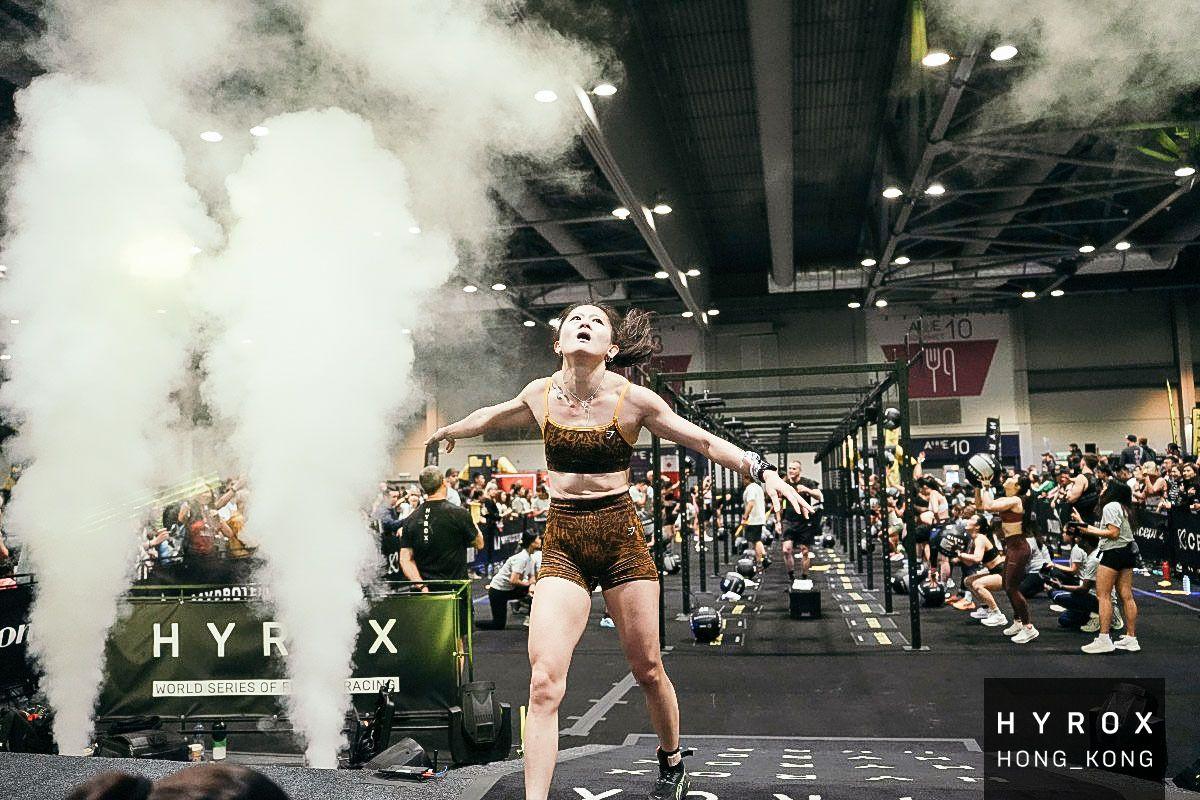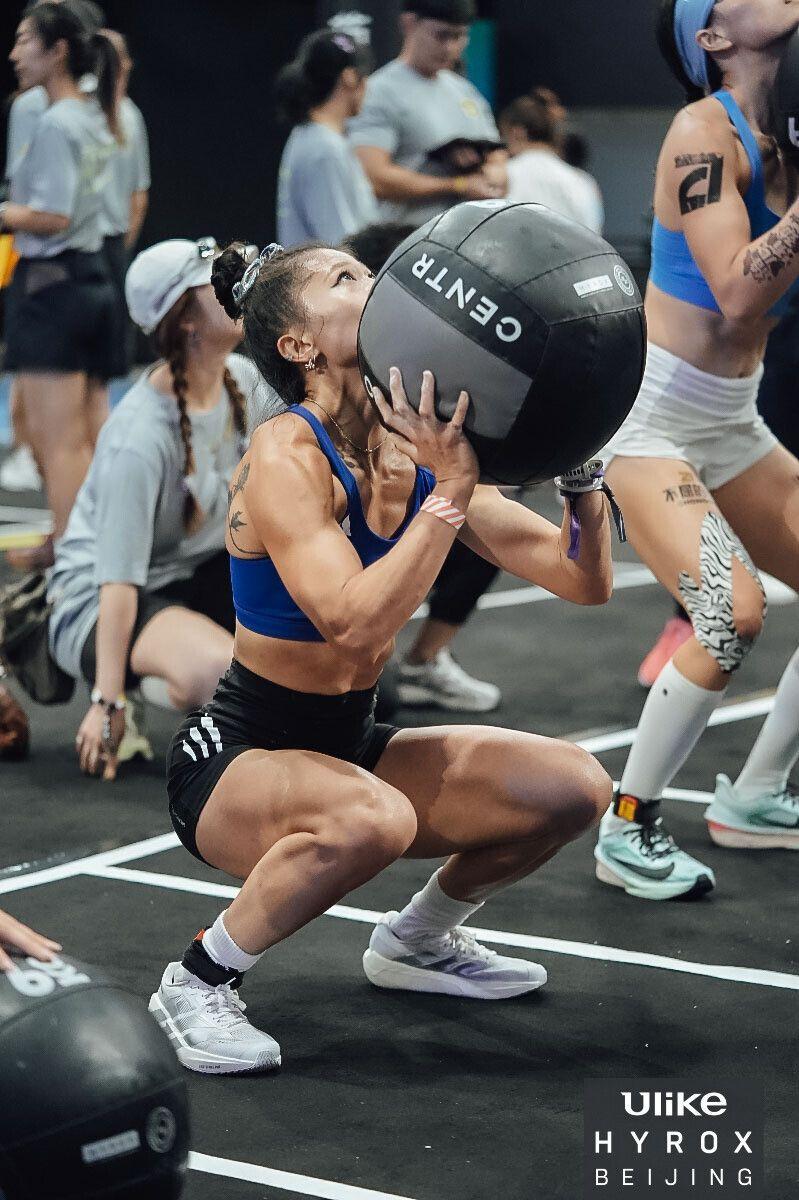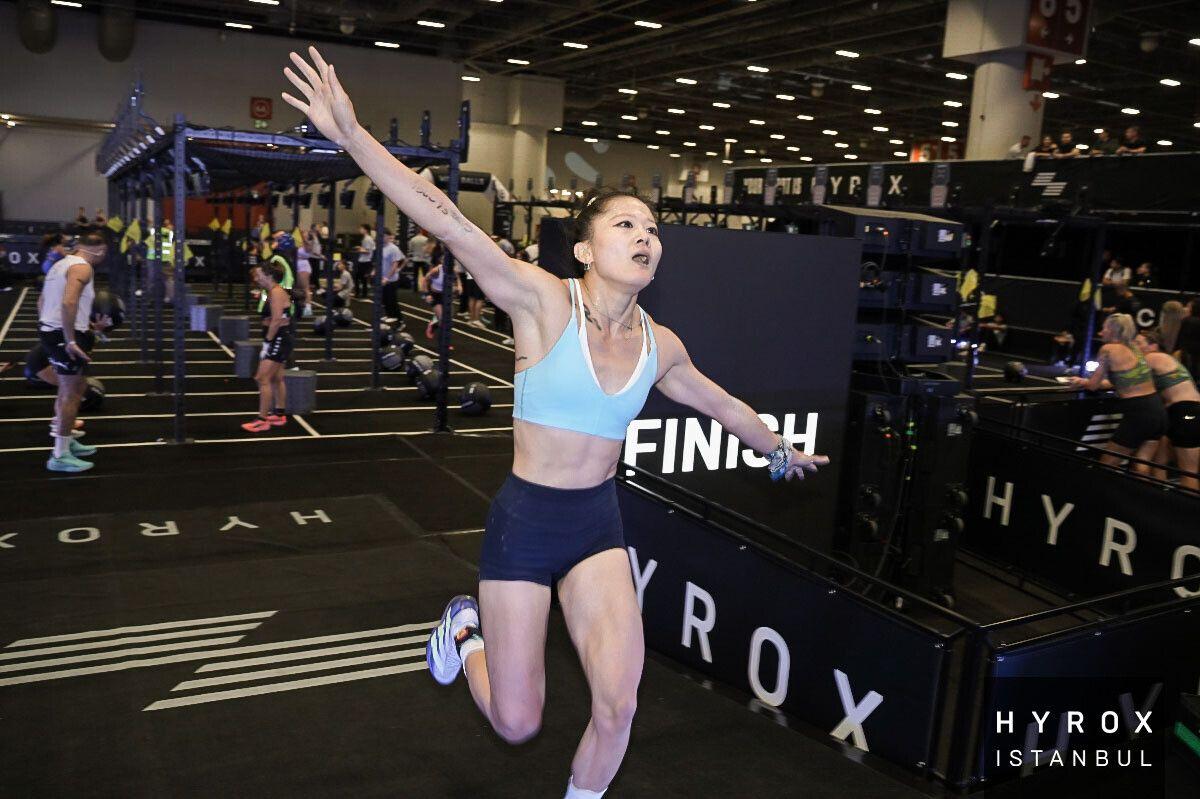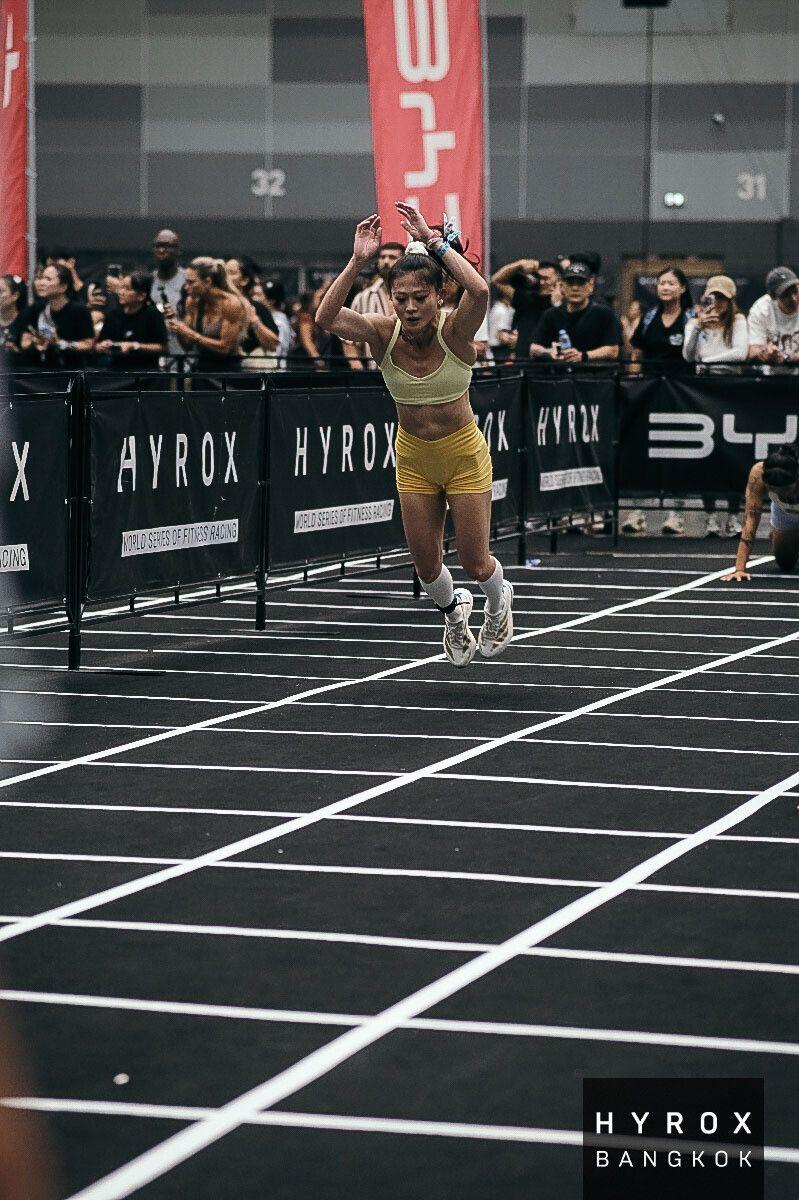
Hi everyone! I'm Pauline Yu (PYY), Taiwan's only 4× Hyrox World Championship qualifier. I still remember the moment the Burpee Broad Jump station almost ended my first World Championship race. I was somewhere around rep 40, my legs felt like wet cement, and I could hear athletes around me either grinding through or — more often — completely falling apart in their movement. That image stuck with me, and honestly it became the reason I became slightly obsessed with this station. Over the next two years of competing across Asia and internationally, I rebuilt my entire approach to the Hyrox burpee broad jump from the ground up, and what I found surprised even me. This is everything I know.
Key Takeaways
- ▸The Hyrox burpee broad jump is 80 metres total, and every single rep demands an explosive two-foot takeoff and landing — sloppy hips and collapsed knees will cost you both speed and injury resilience across all 80 metres.
- ▸BBJ technique for women should prioritise hip hinge depth on the chest-to-floor phase, because rushing this portion destroys your jump position and you end up doing tiny, ineffective hops that slow your total time dramatically.
- ▸Pacing is everything: most athletes blow up in the first 20 metres by going out too fast, then spend the next 60 metres suffering — I recommend a controlled, rhythmic start that you can sustain through the full distance.
- ▸Your arm swing is your secret weapon — driving both arms aggressively forward and upward during takeoff adds meaningful distance per rep, which across 80 metres adds up to several fewer reps completed and real time saved.
- ▸Train the BBJ as a standalone skill at least twice per week in your Hyrox prep block, not just as a conditioning finisher, so your nervous system learns the explosive pattern even when fatigue is already high from earlier stations.
- ▸Recovery breathing during the chest-to-floor and stand phases is a legitimate technique strategy — use those brief moments deliberately to reset your breath so that accumulated oxygen debt doesn't force an unplanned stop mid-station.
Why the BBJ Breaks Athletes — And Why It Broke Me First
Let me take you back to my very first Hyrox World Championship. I had trained hard. I thought I was ready. I'd done plenty of burpees in CrossFit-style workouts and felt comfortable with the movement. What I hadn't done was train the specific, relentless, 80-metre grind of the Hyrox burpee broad jump under real race fatigue. By the time I reached the BBJ station, I had already run multiple kilometres and completed earlier stations. My posterior chain was already talking to me. And then the station started and I immediately made every mistake in the book — I jumped too aggressively in the first ten reps trying to get through it fast, my chest barely touched the floor, and my landing position was so collapsed that each subsequent takeoff was weaker than the last. I finished the station, but it cost me far more time and energy than it needed to. That race taught me that the BBJ is not a burpee with a jump slapped on the end. It is a skill, and it punishes athletes who treat it otherwise.
The reason this is widely considered the Hyrox hardest station comes down to a brutal combination of factors that stack on top of each other. First, it's a full-body movement — you're using your chest, shoulders, core, glutes, hamstrings, and calves on every single rep. Second, it has a higher skill ceiling than people expect, meaning that poor technique compounds into much bigger time losses than, say, sloppy rowing form. Third, it arrives in the race when athletes are already meaningfully fatigued. For women competing in the elite Hyrox women's category, where margins are tight and every second counts, a poorly executed BBJ station can be the difference between a podium finish and not. I've watched this happen at competitions across Taiwan and across Asia — athletes who are fitter than their competition losing positions purely because of BBJ execution. Understanding why it breaks people is the first step to making sure it doesn't break you.
- ▸Never skip the chest-to-floor contact: in competition, judges will no-rep you if your chest doesn't make clean contact with the ground, and rushing this phase also destroys your hip position for the jump, so full contact actually saves you time in the long run.
- ▸Identify your personal blow-up point in training — for most athletes it's around rep 15 to 20 — and deliberately practise pushing through that exact threshold so it stops being a wall and becomes just another part of the workout.
- ▸Film yourself doing 20 continuous BBJ reps in training and watch the footage: you will almost certainly see your jump distance shrinking and your landing position getting sloppier as fatigue sets in, and that footage tells you exactly what to fix.
- ▸Don't compare your pace to the athlete next to you at the start of the station — in every Hyrox race I've run, the person who sprints the first ten reps is very rarely the person who finishes the station fastest overall.
BBJ Technique for Women: The Mechanics That Actually Matter
Let's get into the actual movement mechanics, because this is where most online content falls short. When I started coaching athletes in Taiwan — both beginners and experienced Hyrox competitors — I noticed that women in particular tend to underestimate how much power they can generate from their posterior chain in the jump phase. We often jump with a very quad-dominant pattern, which produces a more vertical jump rather than a long, horizontal one. For the Hyrox burpee broad jump, you want horizontal distance. So the first thing I coach is the hip hinge on the way down: as you drop to the floor, think about loading your glutes and hamstrings, not just falling forward onto your hands. This loaded position is what creates the elastic energy for your push-up, your stand, and your eventual jump. When you do it well, the movement feels almost rhythmic and powerful. When you skip it, every rep feels like starting from zero.
The jump itself has three components that I always break down separately in training before combining them at race pace. First is the arm drive — both arms swing back and then explosively forward as you take off. This is not optional; research in biomechanics consistently shows that coordinated arm swing meaningfully increases horizontal jump distance, and across 80 metres of BBJ that adds up to a real difference in rep count. Second is the knee drive — pulling your knees up during the jump itself keeps your trajectory flatter and longer rather than popping straight up in the air. Third is the landing — you want to land in an athletic stance with soft knees, your weight distributed evenly, and your chest already beginning to tip forward for the next chest-to-floor phase. I practise each of these components in isolation during my warm-up before BBJ training sessions, especially when I'm working on this in Taiwan's humidity, where my muscles feel different and reaction times can be slightly sluggish at the start.
- ▸Practise the arm swing drill in isolation: stand still, hinge at the hips, swing both arms back, then drive them explosively forward and jump — repeat ten times focusing purely on arm-leg coordination before adding the full burpee movement.
- ▸Land softly and in a wide athletic stance — feet shoulder-width or slightly wider — so that your glutes and hamstrings absorb the landing rather than your knees, protecting your joints across the full 80-metre volume.
- ▸Use a visual marker on the floor during training to track your jump distance per rep — even a small piece of tape placed at your target distance creates immediate feedback and motivates you to maintain consistency as fatigue accumulates.
Race-Day Strategy: Pacing, Breathing, and the Mental Game
Everything I've described above means nothing without a smart race-day strategy, and this is the part that I personally struggled with the longest. Technical skill is trainable. Mental composure under race fatigue is a whole other skill set. When I'm competing — whether it's a race in Taiwan, somewhere else in Asia, or on the world stage — the BBJ station feels psychologically enormous. You can see it, you know it's coming, and that anticipation can cause athletes to either go into survival mode too early or, more dangerously, try to sprint through it to get it over with. Neither approach works. The strategy that has served me best, and that I've seen work for athletes I coach, is what I call rhythm-first pacing. This means you set a sustainable rep tempo in the first five reps and you hold it as long as humanly possible, rather than going fast and then breaking.
The breathing strategy is something I worked on specifically after my second World Championship, where I noticed I was holding my breath during the jump phase and then gasping through the push-up. That is a fast route to red-lining your cardiovascular system when your body already has very little reserve left. What I now do — and teach — is a deliberate exhale as I push up from the floor, an inhale as I stand and prepare to jump, and then a sharp exhale on takeoff. It sounds complicated when written out, but after a few hundred reps in training it becomes completely automatic. The mental side is equally important: I break the 80 metres into four segments of 20 metres each in my head, and I only ever think about completing the current 20-metre block. This is a technique I picked up from long-distance running psychology and it has genuinely changed how I experience this station on race day.
- ▸Set your target rep tempo before you reach the station — I count in my head during the first five reps and lock in that rhythm, because a consistent tempo is almost always faster overall than a fast-then-slow pattern.
- ▸Break the 80 metres into four 20-metre mental blocks and celebrate internally each time you complete one — this keeps your mind engaged and prevents the demoralising sense that the station never ends.
- ▸If you feel you must take a micro-rest, take it during the stand phase rather than lying on the floor — standing gives you the option to reset your breath and your mindset, and it signals to your body that you are still in control of the movement.
What the Research Says
Research published in the British Journal of Sports Medicine has consistently shown that plyometric training — explosive jumping movements performed under conditions of progressive fatigue — produces significant improvements in both lower-body power output and movement efficiency over time. This finding maps directly onto what we experience in Hyrox BBJ training: the more your neuromuscular system adapts to producing force under fatigue, the less your technique degrades as the reps accumulate. The Journal of Strength and Conditioning Research has also consistently reported that horizontal plyometric training, specifically movements that demand maximal distance per rep rather than maximal height, responds strongly to arm-swing coordination and hip extension mechanics — which is exactly why I emphasise those two elements so heavily in my own training and coaching. What excites me personally about this science is that it validates what I discovered through trial and error: the BBJ is not just a cardio problem, it's a power-under-fatigue problem, and that type of problem responds to smart, specific training. You don't get better at it by doing more cardio. You get better at it by training the specific skill of explosive jumping when you're already tired, which is a different stimulus entirely.
Frequently Asked Questions
Q: How do I build up to the full 80 metres of BBJ if I'm a complete beginner to Hyrox? A: Start with shorter distances and focus entirely on technique before volume. I tell beginners I coach in Taiwan to begin with 20-metre sets — just five reps — and make every single rep look exactly the same from start to finish. Once you can do 20 metres with consistent form, move to 40 metres, then 60, then the full 80. This progression usually takes about four to six weeks if you're training it twice per week. Don't rush the progression. A 20-metre perfect set teaches your nervous system far more than a sloppy 80-metre attempt where your form falls apart after rep ten.
Q: Should I practise BBJ before or after my running intervals during a training session? A: I always recommend practising BBJ before your running intervals if your primary goal is improving technique, because that's when your central nervous system is freshest and you'll get the highest quality movement patterns. However, if your goal is race specificity — simulating what it feels like to do BBJ with already-tired legs — then doing it after running intervals is actually more valuable. In my personal training cycle, I alternate: one session per week where BBJ comes first for quality, and one session where it comes later for race simulation. Both have a role, and you need both adaptations to race well.
Q: I always feel like my jump distance drops significantly after about rep 15. Is that normal, and how do I fix it? A: Yes, completely normal, and I experienced exactly the same thing for my first year of Hyrox training. Rep 15 to 20 is where your fast-twitch muscle fibres start fatiguing rapidly and your body tries to recruit other motor units that are less efficient for explosive jumping. The fix is twofold: first, build your lower-body plyometric capacity with dedicated broad jump and box jump training outside of BBJ practice so your fast-twitch system has a larger reserve to draw from. Second, really focus on your arm swing after rep 15, because when leg power drops, a strong arm swing can partially compensate and maintain your distance. It won't feel as powerful, but it will keep your reps longer than if you abandon the arm drive entirely.
The BBJ is hard — there's no sugarcoating that. But it's also one of the most trainable stations in the entire Hyrox race, and every athlete I've worked with who has committed to the specific work has seen real, measurable improvement in their time and their experience of the station on race day. I hope this article gives you a real roadmap to owning it. If you want more training content like this, come find me at paulineyuyu.com and subscribe — I share new training insights, race strategies, and personal updates there regularly. Let's build something strong together.
Sources: British Journal of Sports Medicine / Journal of Strength and Conditioning Research
Taiwan's elite HYROX Pro athlete and 4× World Championship qualifier. I share my training journey, race insights, and performance notes from the competition floor.