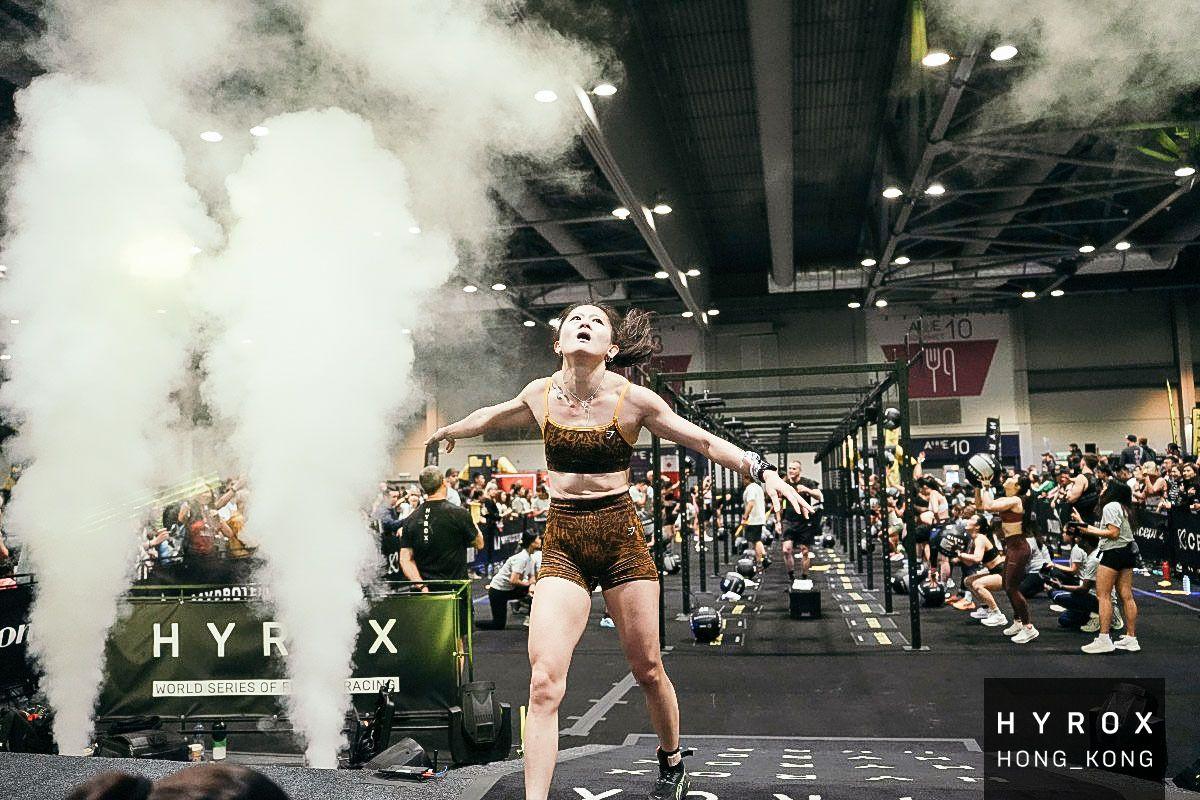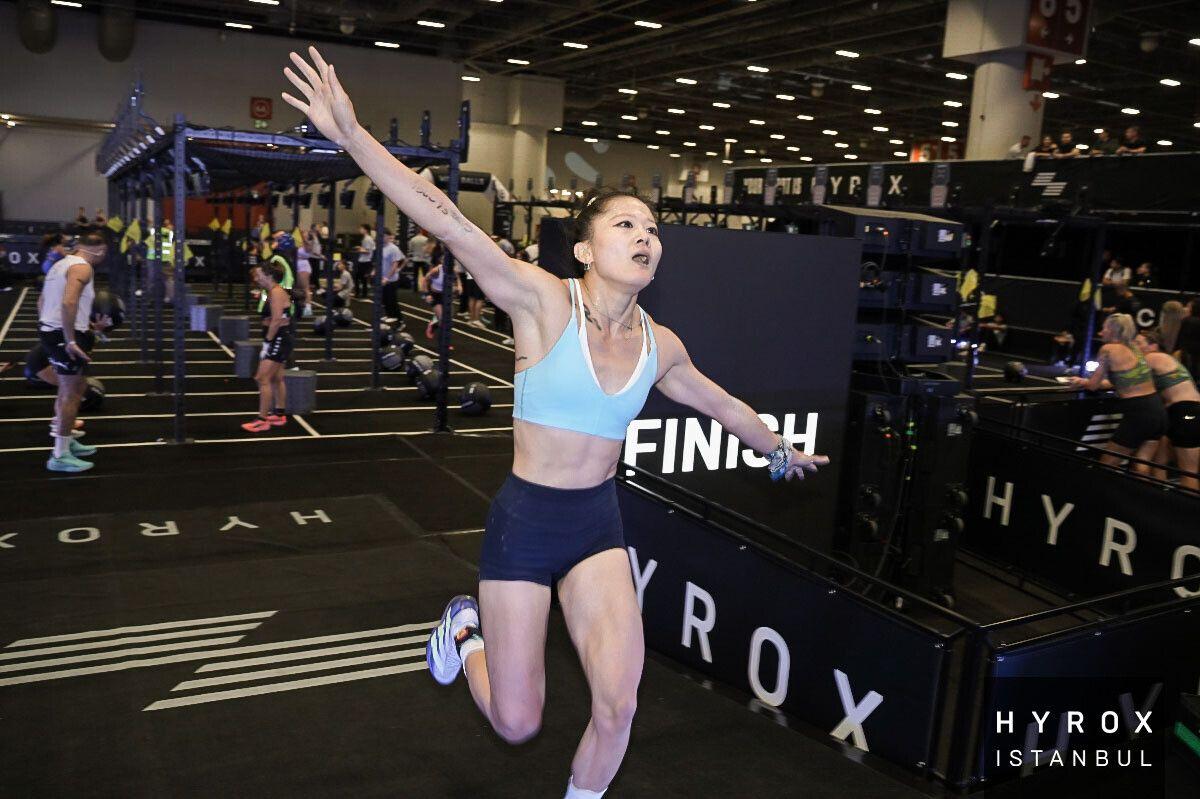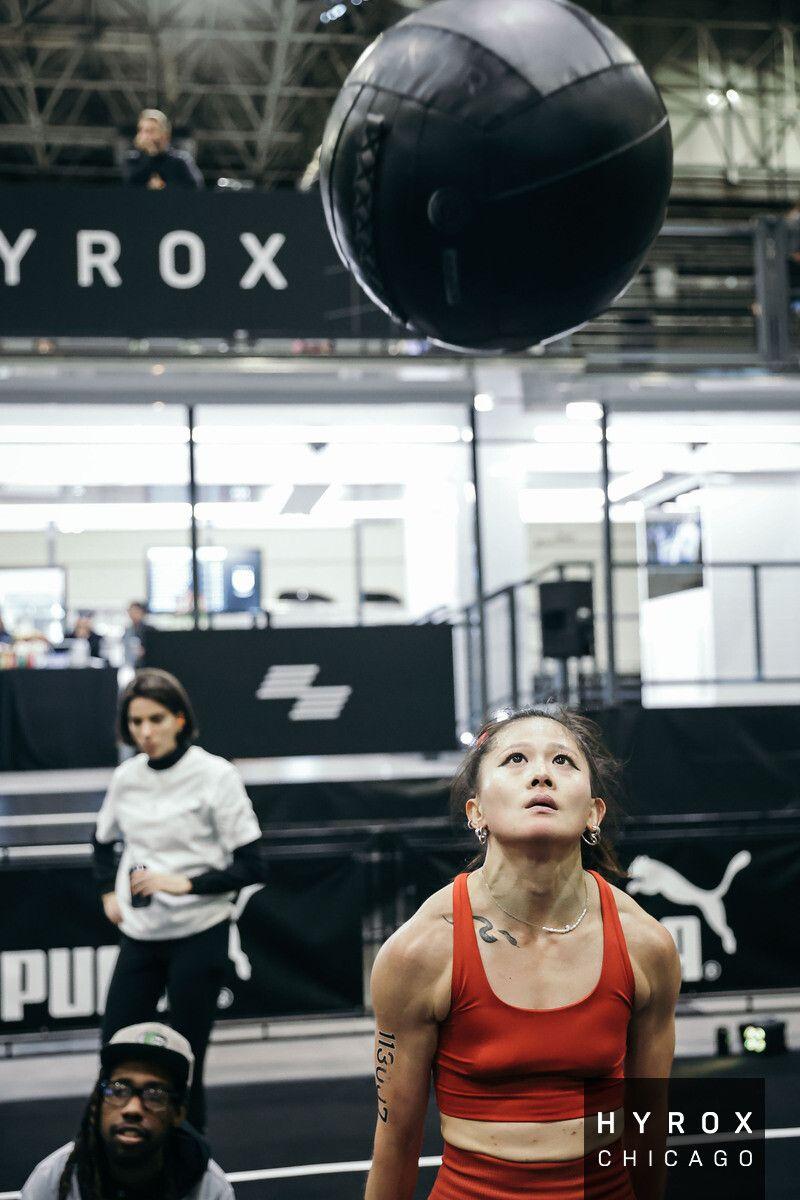
Hi everyone! I'm Pauline Yu (PYY), Taiwan's only 4× Hyrox World Championship qualifier. I still remember standing at the start line of my very first Hyrox World Championship in Hamburg, heart pounding, telling myself I had trained hard enough to go out fast on that opening 1km run. I hadn't. By the third run segment I was shuffling, my legs felt like wet concrete, and I arrived at the Ski Erg completely gassed before I'd even grabbed the handles. That race taught me the single most important lesson in Hyrox running strategy: the 1km run is never just a run. It is a fuel management system, and if you treat it like a standalone sprint, you will pay for it at every single station that follows. Coming back from Taiwan to race again and again, I rebuilt my entire approach to Hyrox 1km run pacing from the ground up, and today I want to share every detail of what I've learned with you.
Key Takeaways
- ▸Never treat the opening 1km as a race — running the first lap at 85–88% of your maximum effort instead of 95%+ is the single biggest pacing adjustment that will protect your station performance across all eight functional fitness stops.
- ▸Use Rate of Perceived Exertion (RPE) rather than pace alone to govern each lap, because your heart rate and fatigue accumulate lap by lap and a fixed pace that felt easy on lap one will feel brutal by lap seven.
- ▸The transition from run to station is where races are won or lost for women's elite Hyrox athletes — slow your final 50–100 metres deliberately, control your breathing, and arrive at the station already mentally locked in on the movement.
- ▸Negative splitting your run segments, meaning running each successive lap slightly faster than the previous one once you have a feel for your body, is a strategy that consistently outperforms going out hard and fading in Hyrox competition.
- ▸Practice your Hyrox running strategy in training by doing interval sessions that specifically simulate the run-to-station transition — finish a tempo interval, drop immediately into burpees or wall balls, and learn exactly what your legs feel like at different effort levels.
- ▸Breathing resets between the end of the run and the start of the station work are not optional luxury — four to six controlled exhales as you approach the station can drop your heart rate by ten or more beats per minute before you begin the functional movement.
Why I Blew Up in Chicago — and What Lap One Really Costs You
When I lined up at my first Hyrox World Championship, I was fit. I had trained hard in Paris for months, logging long runs along the riverside in Paris and hitting the gym four days a week. But I had one massive blind spot: I thought of the eight 1km run segments as separate events, almost like a series of time trials, rather than as one continuous energy conversation with my body. So on that first lap in Chicago I went out at close to my 5km race pace, which felt totally manageable in the moment. And honestly, it was fine for lap one. The problem is that each lap you run above your sustainable threshold chips away at your glycolytic reserves, raises your lactate, and leaves your muscles incrementally more fatigued. By lap three I noticed it. By lap five I was in serious trouble. The stations started taking twice as long as I'd trained for, not because I didn't know how to do the movements, but because I arrived at them completely cooked.
What I didn't understand then — and what took me two more race seasons to fully internalise — is that in Hyrox, your run pacing is actually your station management. Every ten seconds you overspend on a 1km run is roughly forty to sixty seconds of degraded output across the station that immediately follows. For women's elite Hyrox athletes competing at the World Championship level, that math is catastrophic. The athletes I watched finishing ahead of me in Hamburg weren't running faster laps overall. They were running smarter laps. They came off each 1km looking controlled and composed, transitioned smoothly, hit their station targets, and then ran the next lap. That rhythmic, disciplined approach to Hyrox running strategy is exactly what I came back to Taiwan to practice and perfect.
- ▸Set your lap one Hyrox 1km run target at a pace that feels almost frustratingly easy — roughly 85 to 88% of your maximum effort — because you need that physical and mental budget for the seven laps and eight stations still ahead of you.
- ▸Identify a specific landmark or time check within your 1km loop to audit yourself mid-lap — if you're already breathing hard at the halfway point, you have gone out too fast and need to pull back immediately before the damage compounds.
- ▸Think of your perceived effort on the run not as a number to maximise but as a battery percentage to protect — ask yourself after each lap whether you could still do a quality set of the next station exercise, and if the answer is uncertain, you ran too hard.
- ▸Write your target lap time on your wrist or a small card taped to your wristband during training simulations in Taiwan or wherever you train — seeing that number mid-run gives you an objective anchor when your competitive instincts try to push you into the red zone.
The Lap-by-Lap Pacing Blueprint I Use for Every Hyrox Race
After four World Championship qualifications and countless races across Euro amd Asia, I've developed a very specific mental blueprint for how I pace each of the eight 1km run segments in a Hyrox race. It's not complicated, but it requires discipline, especially in the first half of the race when your legs are fresh and every instinct tells you to run faster. I think of the eight laps in three distinct phases. Laps one and two are my settlement phase. Laps three through six are my rhythm phase. Laps seven and eight are my push phase. Each phase has a slightly different energy intent, and understanding this structure transformed my Hyrox running strategy from reactive panic to proactive control. In training sessions back home in Taiwan, I rehearse this three-phase structure every single time I do a full Hyrox simulation workout, so that by race day it is completely automatic.
During the settlement phase — laps one and two — my only job is to find a steady rhythm and resist the crowd energy. Hyrox races are loud, exciting, and full of athletes sprinting past you in the opening minutes. It takes real mental strength to let them go. But here is what I tell myself: most of those athletes will come back to me by lap five. And they do. During the rhythm phase, laps three through six, I'm running at what I call my honest pace — the pace I can sustain while still arriving at each station ready to work at 90% capacity. This is where the real race happens. In the push phase, laps seven and eight, if I've executed the first six laps correctly, I genuinely have something left to spend. I can increase my effort by five to eight percent, run those final laps with intention, and finish strong rather than just survive. This is what separates a managed Hyrox race from a suffering Hyrox race, and it all comes down to having the patience to hold back early.
- ▸Label your eight laps mentally before you race — settlement, rhythm, push — and assign a simple RPE number to each phase (for example, RPE 7 for laps one and two, RPE 8 for laps three through six, RPE 9 for laps seven and eight) so you have a clear internal guide throughout the event.
- ▸Use the first 200 metres of every lap to deliberately regulate your breathing down from the oxygen debt you may have built during the previous station — nasal breathing or a controlled inhale-exhale pattern in those opening metres pays dividends for the rest of the lap.
- ▸During your rhythm phase laps, scan your body systematically — shoulders, arms, hips, feet — to check for unnecessary tension that is wasting energy, because accumulated tension across multiple laps adds up to significant fatigue by the time you hit the later stations like the 100-metre sled push or the farmer's carry.
Training Drills That Build Real-Race Pacing Intelligence
Knowing the theory of Hyrox 1km run pacing is one thing. Being able to execute it under race pressure when your lungs are burning and the crowd is roaring is something completely different. The only way I have found to reliably bridge that gap is through very specific training drills that teach your body to transition from running to functional station work at controlled effort levels. The most valuable drill I do in Taiwan — and one that I think every Hyrox athlete in Asia should add to their training — is what I call the Arrival Drill. It sounds simple: run 1km at your target race effort, then immediately perform the next planned station exercise for the required distance or repetitions. But the magic is in the debrief. After every Arrival Drill, I ask myself: did I arrive in control or in chaos? Did I nail my first few reps at the station or did I need fifteen seconds to collect myself?
Over time, these Arrival Drills calibrate your internal pacing sensor in a way that watching a pace clock on a treadmill simply cannot. You start to associate specific feelings in your legs and lungs with specific outcomes at the station. You learn that arriving with an RPE of 8 means you can do the Ski Erg efficiently, but arriving at RPE 9.5 means your first thirty seconds on the machine are messy and slow. For women's elite Hyrox training, I genuinely believe this kinesthetic calibration is as important as raw aerobic fitness. You can be incredibly fit and still race poorly if you don't know your own pacing signals. Some of my training partners in Asia have transformed their race times not by running more or lifting more but simply by getting smarter about how they connect their run effort to their station readiness.
- ▸Do at least one full Hyrox simulation per training block where you run every single one of the eight 1km segments and complete each station at race intensity — there is genuinely no substitute for feeling the cumulative fatigue that a real race produces, and simulating it in training removes the surprise on race day.
- ▸Add run-to-station transition drills into your weekly schedule two to three times per week — finish a 1km tempo run and immediately roll into wall ball shots, burpee broad jumps, or rowing at your target station pace, and note what your effort level felt like on the run before you transitioned.
- ▸Practice what I call the fifty-metre slowdown — in the final fifty to one hundred metres of every training run before a station transition, consciously reduce your cadence by ten percent and begin your breathing reset, so that this movement becomes automatic and costs you almost no time while delivering a meaningful drop in heart rate before you hit the station.
What the Research Says
The science here is genuinely reassuring because it backs up what I've learned through hard experience. Research published in the British Journal of Sports Medicine has consistently shown that in multi-stage endurance events combining running with resistance-based exercise, athletes who distribute their aerobic effort more evenly across all running segments achieve significantly better overall performance than those who front-load their effort in early stages. This aligns exactly with what I experienced in Hamburg and what I've seen across Asian Hyrox competitions. The body's ability to perform quality functional movement — the Ski Erg, the sled push and pull, the burpee broad jumps, the wall balls, all of it — degrades meaningfully when it is paired with an elevated lactate load carried over from aggressive running. Research in the Journal of Strength and Conditioning Research has also established that the lactate clearance rate during moderate-intensity running is substantially faster than during high-intensity running, which means that running at a controlled, honest pace between stations actively helps your body recover from the previous station's effort rather than adding to an already growing debt. This is the physiological reason why conservative pacing in Hyrox isn't just about comfort — it is about keeping your functional movement quality high for the full duration of the event. Every time I return to Taiwan after a World Championship and review my splits with my coach, we see this pattern confirmed again and again.
Frequently Asked Questions
Q: As a beginner, how do I figure out what my Hyrox 1km run pace should actually be? A: This is such an important question and I wish someone had answered it clearly for me when I was starting out. The most practical approach is to do a standalone 1km time trial and note your finishing time, then add thirty to forty-five seconds to that time and use it as your target Hyrox race pace. The reason is that you need to sustain that pace across eight laps while doing functional station work in between. In practice, when I started out in Taiwan, I used a simple test: run 1km, immediately drop into ten wall ball shots at race weight, and check how controlled my movement quality was. If my wall balls were clean, my run pace was sustainable. If they were sloppy and I was gasping, I had run too hard. Use quality of movement at the station as your pacing feedback mechanism, not just split time on the run.
Q: Should I try to run every lap at exactly the same pace, or is it okay for the later laps to be slower? A: From my experience — and this is something I debated with coaches for a long time — aiming for even or slightly negative splits is more effective than accepting progressive slowdown. Yes, it is completely natural to feel more fatigued on lap seven than lap one. But if your pacing is intelligent and your station work is well-managed, the fatigue accumulation should be gradual enough that you can still hold roughly the same pace through the middle laps and even find a bit more in the final two. The athletes I've watched in women's elite Hyrox at the World Championship level aren't dramatically slowing on later laps. The difference between a great Hyrox run and a poor one is almost always about lap one and two being too fast, not about the later laps being too slow. Protect the first half and the second half tends to look after itself.
Q: How do I practise Hyrox running strategy if I don't have access to a proper Hyrox gym in my city? A: I totally understand this challenge — when I first got into Hyrox in Taiwan, proper Hyrox facilities weren't as widespread as they are now across Asia. The honest answer is that you can build almost all of the run pacing intelligence you need with a treadmill or outdoor track combined with basic functional equipment. Set your treadmill to your target Hyrox pace, run for four to five minutes to simulate a 1km effort, then jump off and do your station substitute — kettlebell swings for ski erg, a sandbag carry for the farmer's carry, box jumps for burpee broad jumps. The specific equipment matters less than practicing the transition from running to working at controlled effort. Do this consistently, track your station performance quality after each run, and you will build real Hyrox pacing intelligence without ever stepping into a formal Hyrox box.
Thank you so much for reading — I genuinely love sharing these lessons because they came from real pain, real failures, and a lot of time training and racing across Asia as a woman in this incredible sport. If you found this useful, I'd love for you to come join my community at paulineyuyu.com where I share weekly training content, race breakdowns, and honest insights from my journey as Taiwan's top female Hyrox athlete. Subscribe and let's keep building together — see you on the race floor!
Sources: British Journal of Sports Medicine / Journal of Strength and Conditioning Research
Taiwan's elite HYROX Pro athlete and 4× World Championship qualifier. I share my training journey, race insights, and performance notes from the competition floor.