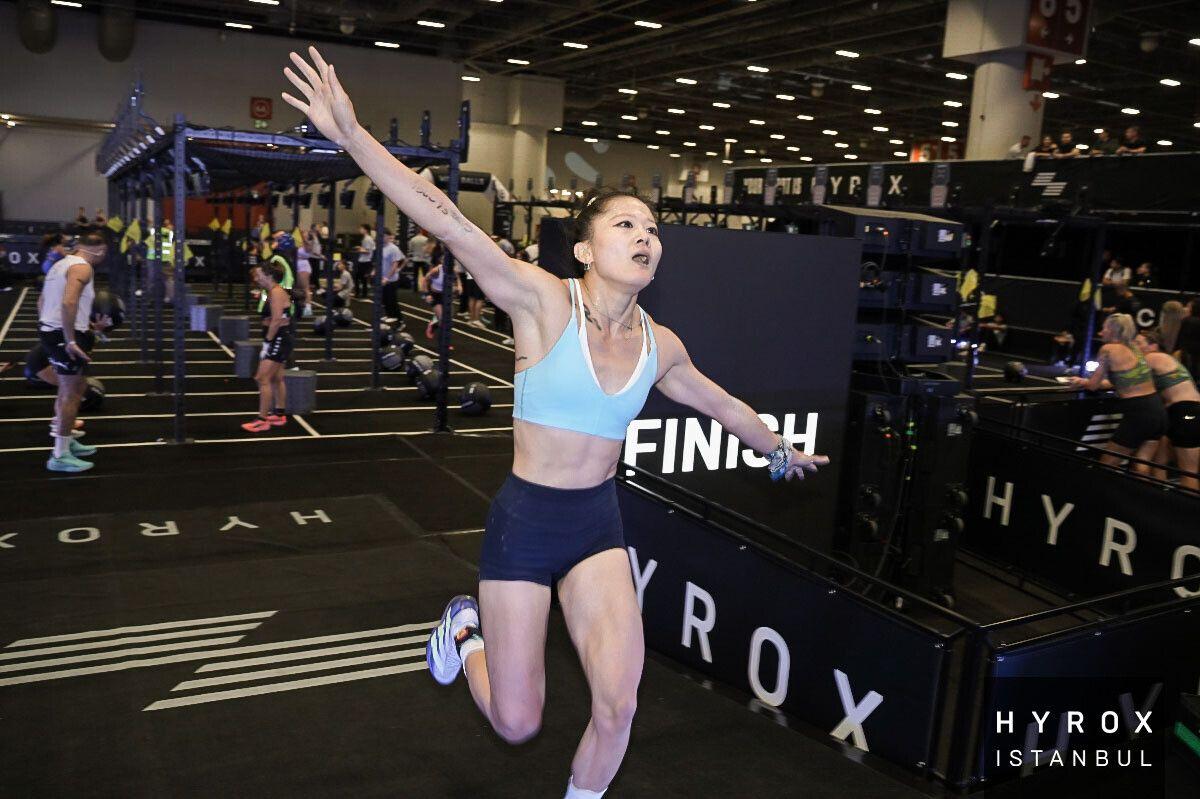
Hi everyone! I'm Pauline Yu (PYY), Taiwan's only 4× Hyrox World Championship qualifier. I still remember sitting in the crowd after my very first Hyrox race, sweaty and completely wired on adrenaline, staring at my phone trying to make sense of the results page. I had finished, I had survived, and I had no idea whether my time was good, average, or completely embarrassing. I scrolled through the Hyrox leaderboard guide for what felt like an hour before I finally figured out how to filter by division and actually find my own name. That moment of confusion was a turning point for me — I realized that reading your results properly is its own skill, and most athletes, especially women just starting out in Taiwan and across Asia, never get taught how to do it. So today I want to fix that.
Key Takeaways
- ▸The Hyrox leaderboard is searchable by event, division, gender, and nationality — always filter to your exact category before comparing times, or you will be reading data that has nothing to do with your race situation.
- ▸Your running splits and your station times are reported separately on the results page, which means you can immediately identify whether your weakness is cardiovascular endurance or functional strength — and train accordingly.
- ▸For women's elite Hyrox, the top 10 percent benchmark globally is a powerful reference point — use it to set a realistic A-goal, B-goal, and C-goal structure for each race so you always leave with something to celebrate.
- ▸Reading Hyrox ranking women data from your own region — especially Taiwan and broader Asia — gives you a more relevant comparison than global averages, because course conditions, athlete pools, and race-day temperatures vary enormously.
- ▸Tracking your leaderboard position across multiple races over time is more motivating and more honest than obsessing over a single finish time — progress shows up in percentile movement, not just seconds dropped.
- ▸Screenshot and save your full split breakdown after every race before the results page updates — historical data sometimes disappears or gets restructured, and your personal records are irreplaceable training intel.
Finding Your Place: How I Learned to Actually Read Hyrox Results
When I started competing, I treated the Hyrox leaderboard like a report card I was scared to open. I would glance at my finishing time, wince or cheer depending on whether it matched some vague number I had in my head, and then close the tab. It took me until my second season to realize I was throwing away one of the most valuable feedback tools available to any Hyrox athlete. The results page doesn't just tell you where you finished — it tells you a story about how you raced, station by station, kilometer by kilometer. Once I learned to read Hyrox results properly, my training completely changed. I stopped guessing what to work on and started using actual data to drive every decision. If you are a woman competing in Taiwan or anywhere in Asia, learning this skill will give you a serious edge because most of your competitors haven't bothered to dig this deep.
Here's the practical starting point: go to the official Hyrox results portal and use the filter system before you do anything else. You can filter by event city, by year, by division (Open, Pro, Elite), and by gender. If you are a woman competing in the Open division, you want to be looking at women's Open results only — comparing yourself to the Pro women or to the overall mixed leaderboard will give you completely warped expectations. Once you are in the right filter, find your own result and look at two columns side by side: your running times for each of the eight one-kilometer running segments, and your station times for each of the eight Hyrox workout stations. These two data streams will immediately show you your strengths and your holes. For me, early on, my ski erg and sled push times were competitive but my running splits in the second half of the race fell apart — and seeing that in black and white forced me to take my aerobic base training seriously in a way that no coach's verbal feedback had ever quite managed.
- ▸Always filter to your exact division and gender before reading any Hyrox leaderboard data — mixed or wrong-division comparisons will either crush your confidence unfairly or give you false comfort about where you actually stand.
- ▸Download or screenshot your full split breakdown — including each individual running kilometer and each station — immediately after results go live, because this granular data is the most actionable training feedback you will ever get for free.
- ▸Compare your station times not just to the overall winner but to the athlete who finished exactly 10 percent above you in the rankings — that gap represents your most realistic next step, and it is usually smaller and more achievable than you expect.
- ▸Look for your running fade pattern across the eight running laps — if your times consistently get slower after lap four or five, that is a clear signal that your aerobic capacity needs more attention in training, regardless of how strong your station numbers feel.
Using Hyrox Ranking Women Data to Build a Goal Structure That Actually Works
One of the biggest mistakes I see women make when they first get serious about Hyrox — and I made this mistake myself — is setting one single goal time for a race and then feeling like a failure if they miss it by even a few minutes. Racing is unpredictable. Course layouts differ slightly between venues. The temperature in an indoor Singapore venue feels nothing like racing in a European arena in winter. The competitive depth of the field in Taiwan races has grown enormously in the last few years, which means the same finishing time that put you in the top 20 percent two years ago might put you in the top 30 percent now. A rigid single goal ignores all of this context. What the leaderboard data allows you to do instead is build a three-tier goal system — an A-goal, a B-goal, and a C-goal — all anchored to real percentile data from your specific division.
Here is exactly how I build my own race goals using the Hyrox ranking women data. First, I pull the results from the most recent race held in a similar venue type and climate to the one I am preparing for. Then I identify three time benchmarks: the time that would put me in the top 10 percent of my division (that's my A-goal, the stretch), the time that represents the median of my division (that's my C-goal, the floor — achieving this means I had a solid but not exceptional day), and a time roughly halfway between those two points (that's my B-goal, the realistic target I train toward). When I prepare for races representing Taiwan on the world stage, I also look at the leaderboard data from other Asian athletes competing in women's elite Hyrox divisions, because understanding the regional competitive landscape helps me calibrate not just for one race but for a full season of progression. This layered goal structure means I almost always leave a race with at least one win to build on — and that emotional continuity matters enormously for long-term motivation.
- ▸Build a three-tier race goal system using real leaderboard percentile data: an A-goal in the top 10 percent of your division, a B-goal at roughly the top 25 percent, and a C-goal at the median — so you always have a meaningful target to chase regardless of how race day unfolds.
- ▸When setting goals for races in Taiwan or Asia, look specifically at results from venues with similar indoor conditions and athlete pool sizes — global averages can be misleading because elite European race fields tend to be significantly deeper and faster than regional fields.
- ▸Track your percentile position across every race you complete, not just your raw finishing time — moving from the 50th percentile to the 35th percentile over six months is genuine, measurable progress even if your time only improved modestly because the field got stronger around you.
Advanced Leaderboard Tactics: What Elite Women Know That Beginners Don't
After four World Championship qualifications and years of digging into Hyrox results data — both my own and the athletes I look up to — I have picked up a few tactics that I rarely see discussed publicly. The first is what I call station benchmarking against your running peer. Here is what I mean: find the woman in the results who ran the same total running time as you, then compare your station times to hers. If she finished significantly higher than you did, that tells you that your functional strength stations are your limiter. If you finished higher despite having similar running splits, you are already leveraging your strength advantage well. This comparison removes the confounding variable of running ability and isolates pure station efficiency — something that is almost impossible to understand without the leaderboard data laid out in front of you.
The second tactic is using historical leaderboard data to project realistic improvement timelines. I know women in the Taiwanese Hyrox community who get frustrated because they feel like they are training hard but not improving. When I sit down with their results data across multiple races, the improvement is almost always there — it is just slower than they expected and they hadn't been tracking percentile movement, only raw time. Research in the Journal of Strength and Conditioning Research has consistently shown that performance adaptation in hybrid endurance-strength sports follows a nonlinear curve — meaning your biggest jumps often come after a plateau, not at the beginning of training. Understanding this through the lens of your own leaderboard history helps you stay patient and trust the process. The third tactic is using the leaderboard to identify which specific Hyrox stations have the highest variance in women's results — those high-variance stations are where smart training investment pays off the most, because even modest improvements there move you past a large cluster of competitors.
- ▸Find your running peer in the results — the woman with a similar total running time to yours — and compare your station splits directly to hers, because this isolated comparison reveals your true functional strength gaps without the noise of cardiovascular differences.
- ▸Track your percentile ranking across at least four consecutive races before drawing any conclusions about your development trajectory — single-race results are noisy data points, but four or more races will reveal a clear and honest picture of your actual progress curve.
- ▸Identify the two Hyrox stations where women's results in your division show the highest time spread from fastest to slowest — those are the stations where targeted training investment yields the biggest leaderboard position gains relative to the time you put in.
What the Research Says
The habit of using performance data to set structured, tiered goals is not just an athlete intuition thing — there is solid science behind it. Research in the British Journal of Sports Medicine has consistently shown that athletes who set specific, data-anchored performance goals demonstrate significantly better adherence to training programs and greater performance gains over time compared to athletes who train toward vague outcome goals like 'I want to get faster.' The mechanism is partly psychological — specific goals reduce anxiety and increase perceived competence — and partly practical, because data-anchored goals force you to confront the specific gaps in your performance rather than training your strengths indefinitely. Research in the Journal of Strength and Conditioning Research has also consistently shown that in hybrid sports that combine endurance and strength demands — which is exactly what Hyrox is — athletes who periodically analyze split-level performance data (meaning individual segment or station times, not just total time) make better training decisions and improve more efficiently than those who only track overall finish results. For me personally, this research mirrors exactly what happened when I started treating my Hyrox leaderboard data seriously. My training became more targeted, my confidence grew because I could see micro-progress between races, and my World Championship qualification times came down in a way that felt logical rather than lucky. If you are serious about women's elite Hyrox in Taiwan or anywhere in Asia, please don't sleep on this data. It is sitting there waiting for you every time you finish a race.
Frequently Asked Questions
Q: Where exactly do I go to find the official Hyrox leaderboard and read my results? A: Head to the official Hyrox website and navigate to the Results section — you will find a searchable database where you can filter by event location, year, gender, and division. I always recommend bookmarking this page and checking it within 48 hours of a race, because that is when the full split data including individual running laps and station times tends to be most reliably populated. If you are based in Taiwan and raced at an Asian event, you can filter by country to see how you compare specifically within the Taiwanese and broader Asian women's field — which, honestly, is often more motivating than being immediately swallowed by the global results pool.
Q: I'm a beginner Open division woman — is the Hyrox leaderboard even relevant for someone at my level, or is it only useful for elite athletes? A: This is honestly one of the questions I care most about answering, because I used to think the leaderboard was only for serious competitors. It is completely relevant for beginners, and I would argue it is actually more valuable at the early stages because the improvement margins are so much larger and more satisfying to track. As a beginner, your station times will likely show big variance compared to more experienced women — and that variance is pure opportunity. Use the leaderboard to identify your two or three worst stations relative to the median of your division, then make those your training priorities for the next race. That targeted approach will move your ranking faster than generic training ever could.
Q: How do I compare myself to other women in Taiwan or Asia specifically, rather than the global field? A: On the official results portal, there is typically a nationality or country filter that lets you isolate results by region. I use this regularly when I want to understand where Taiwan stands in the broader Asian women's Hyrox landscape. For a more granular comparison, you can also manually sort the filtered results by time and count how many Taiwanese or Asian women finished ahead of and behind you. I know it sounds old-school, but building a simple spreadsheet with your percentile position within the Taiwan field across multiple races is genuinely one of the most motivating tracking tools I have ever used — it makes the community feel real and the competition feel meaningful rather than abstract.
Thank you so much for reading all the way through — this topic genuinely excites me because I believe that smarter data habits are one of the biggest untapped advantages for women in Hyrox, especially here in Taiwan and across Asia where our community is growing so fast. If this helped you see the leaderboard in a new way, I would love to keep the conversation going. Head over to paulineyuyu.com and subscribe for more training content, race prep breakdowns, and everything I learn along the way chasing my next World Championship. See you there — PYY.
Sources: British Journal of Sports Medicine / Journal of Strength and Conditioning Research
Taiwan's elite HYROX Pro athlete and 4× World Championship qualifier. I share my training journey, race insights, and performance notes from the competition floor.